











































Engaging Participants in Community-Based Research
This SHARE policy brief describes community engagement in research using the definition: "In its simplest terms community engagement seeks to better engage the community to achieve long-term and sustainable outcomes, processes, relationships, discourse, decisionmaking, or implementation." - Penn State
The 4-page brief contains guidelines gleaned from a community dialogue in Malawi to explore issues of trust around community-based research. It highlights "the objectives and structure of the event, common challenges expressed by community members, and offers recommendations for researchers and implementing agencies working directly with communities to strengthen good practice."
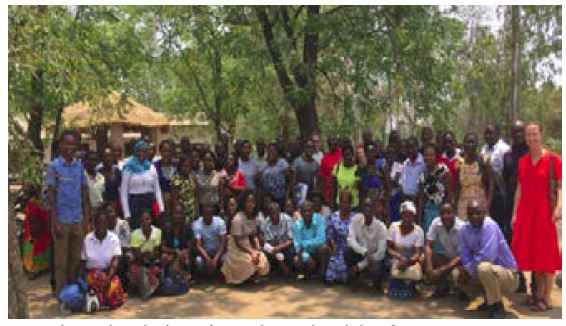
A workshop called the Nchalo Community Café was conducted in rural Chikwawa, Southern Malawi, in October of 2017. The event included a "range of community members (n=29), community leaders (n=8), government extension workers (n=14) and researchers (n=18). Participants were divided into groups of up to five people, facilitated by a table host, and group members rotated every 20 minutes" using dialogue, written response, illustrations and video blogging to try to match levels of literacy and facilitate participation. Benefits and challenges were recognised. The following are recommendations:
"Phase 1: Community Entry:
- Researchers must obtain approval from the district committees, community leaders and other key groups before starting their research.
- When entering a community, researchers must carry a form of identification and show to community members when asked.
- Researchers and enumerators should dress decently and appropriately.
- Researchers must notify district extension workers, village leaders and community members in time before arrival at the project site.
- Research projects and organisations should be explained on arrival to avoid confusion between studies.
- Researchers should involve community members as volunteers in the project for activities that require their expertise.
Phase two: Collection Methods and Tools
- Researchers should clearly explain the inclusion and exclusion criteria of a study to ensure community members understand why only certain people are involved in the intervention.
- Researchers should clearly explain why they need to take samples and what these samples will be used for to avoid misconceptions.
- Interviewer should explain how they are collecting data - for example if using tablets or phones they should demonstrate how this is done to avoid appearing rude.
- During interviews, enumerators should be friendly and patient when asking questions.
- During observations, enumerators should inform participants that all information is confidential and will not be shared with other community members.
- Research teams should train community members properly to use resources given to them during interventions.
Phase 3: End-of-Collection Feedback
- At the end of a project, researchers should provide feedback to the community in a timely manner (e.g. within 2 months of completion).
- Feedback should be at all levels including household if information is confidential."
It was further recommended that policy makers provide national guidelines for community engagement in research.
4
SHARE website, September 27 2018.
- Log in to post comments