










































Empowering Village Education: Improving Enrolment and Retention of Girls in Primary Schools in South Sudan
Africa Educational Trust (AET)
This 25-page report highlights findings from an evaluation of project designed to improve enrolment and retention of girls in primary schools in south Sudan. According to the report, enrolment of girls in primary schools in South Sudan is particularly low, and in response, the Africa Educational Trust (AET), in cooperation with the Government of South Sudan (GoSS) and Ministry of Education introduced the Empowering Village Education (EVE) project in 2008. The project adopted a community-based approach to provide support for 100 of the most disadvantaged primary schools and communities in four of the ten states of South Sudan (Lakes, Central Equatoria, Western Equatoria, and Jonglei). Data was collected to monitor project impact over the duration of the programme and to build up a more comprehensive understanding of the state of education within marginalised communities across the four states of South Sudan. According to the evaluations, the findings indicate that a range of focused interventions such as those supported by the EVE project can help to improve enrolment and retention of girls in primary schools in South Sudan.
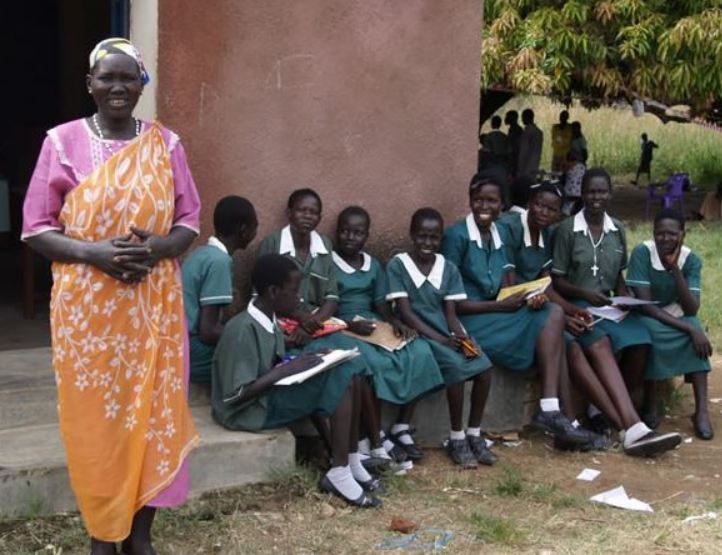
One key objective of the project was to improve the enrolment and retention of girls in the project schools. A number of project activities were designed to help achieve this objective including advocacy training, the development of relevant teaching and learning materials, community managed school development grants, and a "School Mother" scheme. In South Sudan there are very few female teachers and at the start of the project only 23 of the EVE schools had one or more female teachers. This meant that there was a lack of female role models and mentors for girls in school. The School Mother scheme was developed to help fill this gap. 100 women from the EVE communities were selected to be trained as School Mothers. The main goal was to get more girls enrolled and remaining in school through providing a more supportive school environment. School Mothers support and encourage girls with their education both in and out of school by providing advice, assistance, and information on issues such as health and sanitation. They represent girls' views and needs to head teachers, parent teacher associations (PTAs), and the Ministry of Education, undertake advocacy work within the community, conduct home visits, and raise awareness of the importance and right to education for girls. According to the final external evaluation School Mothers were the best executed component of EVE and provided inspiration to children, parents, and the wider community.
The evaluation showed the following results:
- Overall trend in enrolment in EVE schools 2008 - 2010: Between 2008 and 2010, the total enrolment in the 64 EVE schools increased by 1,256 pupils. There was a decrease in primary 1 enrolment but an increase of 2,492 pupils across all other grades suggesting fewer drop outs. The external project evaluation attributed increased enrolment to children joining EVE schools from neighbouring schools, enrolment of out of school children, and reduced drop out and absenteeism. The consistent feature of the EVE primary schools across all four states remains that the vast majority of pupils are in the lower classes. The higher the grade, the smaller the number of pupils enrolled. This trend is consistent with that for primary education in the states as a whole. For instance, in 2010 EMIS data shows that there are 155,944 fewer pupils in grade 8 compared to the number enrolled in grade 1, implying that less than 5% of pupils enrolling in grade 1 reach grade 8, although other factors may be involved. The gap between grades has reduced, implying that more students are progressing through primary school. For example, in 2008, approximately 49% of students progressed to primary 2, increasing to 58% in 2010. The biggest change in EVE schools, from 2008 to 2010, appears to have occurred in Lakes, where there was a decrease of 1,058 pupils in primary 1 pupils but an increase of 1,469 across other grades. This appears to reflect major changes within individual EVE schools for example between 2008 and 2010 some schools saw up to 600 fewer pupils attending as a result of communities being evacuated due to insecurity. Other EVE schools took on over 500 additional pupils as other nearby schools closed or merged with the EVE schools. The school closures partly result from the State Ministry in Lakes closing a number of primary schools in 2007 and 2008 in part to reduce the teaching budget.
- Enrolment and retention of girls in EVE schools, 2008 – 2010: The increase in the number of girls enrolled in the EVE schools over the course of the project is greater than the increase in the number of boys enrolled. In 2010, there were an additional 1,122 girls enrolled compared to an increase of just 134 boys. This difference reflects the decrease in enrolment in primary 1. In 2010, 17% fewer boys were enrolled in primary 1 in EVE schools compared to 7% fewer girls. Increases in total enrolment across grades 2 - 8 indicates better rates of retention in primary school. As a result, the percentage of girls enrolled in EVE schools has increased across all grades and overall from 33.6% to 36.4% showing progress towards gender equity. The schools selected for EVE were some of the more disadvantaged in the states and as such the gender gap was significantly higher in the EVE schools at the start of the project than for the states as a whole. However, between 2008 and 2010, EVE schools made better progress towards gender equity showing a clear increase in the percentage of girls enrolled, while gender parity has changed little for the states as a whole.
- Overview of enrolment and gender by state: For EVE schools in Central Equatoria the percentage of girls as a proportion of total enrolment increased from 38.7 to 42.9% an increase of 4.2%. In comparison, state data indicates that the percentage of girls in primary schools in Central Equatoria increased from 43.9 to 46.1%, an increase of just 2.2%. The EVE schools in Central Equatoria were all located in Juba County. EMIS data for Juba County shows that the percentage of girls in the county increased by 3.5% still below the increase in EVE schools. In Jonglei, there was a 2.3% increase in the percentage of girls in EVE schools compared to 2.5% for schools in the state as a whole. The increase in the percentage of girls for the state as a whole appears to be concentrated in four counties of the state: Akobo, Old Fangak, Pibor and Porchalla. EVE schools, however, were located in different counties: Bor, Twic East, and Duk counties. In these counties, there was an increase of just 1.1% in the percentage of girls in primary schools, compared to the 2.3% increase in EVE schools. The percentage of girls enrolled in EVE schools in Western Equatoria increased from 38.7% to 40.7%. In comparison, state data showed the percentage of girls decreased by 0.2% between 2008 and 2010 for schools in the state as a whole. EVE schools were based in Yambio and Nzara counties. According to EMIS data, there was an increase of just 0.2% in the proportion of girls in primary schools in these two counties. In contrast, in EVE schools the proportion of girls has increased by 2%.
The report explains that although the EVE schools were more disadvantaged, data collected from the 64 EVE schools shows that substantial progress has been made towards improving the enrolment and retention of girls in these schools. The percentage of girls has increased from 33.6 to 36.4%, representing an additional 1,122 girls in school. In comparison, EMIS data for non-EVE schools in the four states shows an overall increase in the percentage of girls in school of just 0.8%. In 2008 the enrolment of girls was significantly lower in the EVE schools than in the state schools generally. Between 2008 and 2010, the rate of improvement towards gender equity was significantly greater in EVE schools compared to non-EVE schools. In addition, progress towards girls reaching the upper grades (4 – 8) of primary school has significantly improved in EVE schools compared to non-EVE schools. This reflects the positive impact of the EVE project, including the School Mothers scheme. Several of the project activities may have impacted on improved enrolment and retention of girls. These could include the school improvement projects including building of latrines and classrooms, provision of uniforms for girls, and the use of Social Issues Kits in lessons to increase understanding on cross cutting issues including gender, human rights, HIV/AIDS, disability, and health. However the external final evaluation noted that the School Mothers scheme was the 'best executed component of EVE'.
AET website on December 9 2013.
- Log in to post comments