










































The Effect of Participatory Radio Campaigns on Agricultural Improvement Uptake: A Preliminary Case Study Assessment
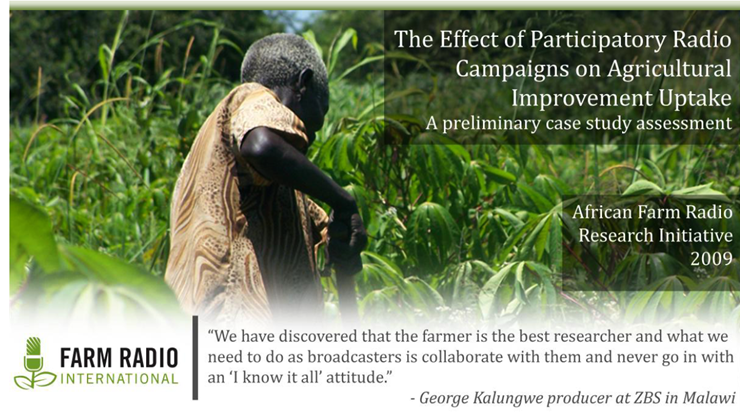
This 43-page report, published by Farm Radio International, summarises the results of five case studies from the African Farm Radio Research Initiative's (AFRRI) Participatory Radio Campaign (PRC). The campaign involved working with five partner radio stations in each of five African countries - Tanzania, Uganda, Mali, Ghana, and Malawi. The PRCs were designed to help smallholder farmers understand, evaluate, and introduce specific agricultural practices that can improve their family's food security.
AFRRI was launched in 2007 with the goal of designing and implementing a participatory, multi-stakeholder action research programme to discover, document, and disseminate best practices for using radio-based communications to enhance food security in Africa. According to authors, AFRRI represents one of the first attempts undertaken to systematically measure the effects of farm radio programmes on the practices and knowledge of farmers, extension workers, and others involved in helping smallholder farmers achieve greater food security.
The report explains the key elements in a PRC, which begins with a radio station working with farmers to identify a single agricultural improvement that could produce significant, measurable improvement in food and nutrition security for local families. The improvement becomes the central feature of a weekly series of radio programmes that extend over a period of four to six months. These programmes follow a sequence of stages that include: launching the campaign; discussing the improvement; encouraging farmers to make an informed decision about adopting the improvement; and discussing how to implement the improvement and troubleshooting any problems encountered.
The five case studies represent an interim assessment of the programme to provide early evidence of the outcomes of five PRCs. Specifically, they looked at PRCs with the following themes: disease-resistant Akena cassava in Uganda; NERICA rice in Ghana; improved composting in Mali; improved chicken management, particularly the construction of chicken enclosures in Tanzania; and planting vetiver grass as a soil and water conservation measure in Malawi.
According to the assessment, one of the main trends observed in all five case studies was a clear increase in the percentage of farmers currently practicing or planning to introduce improvements in practice after the completion of the PRC. In some cases, the increase was remarkable. For example, a PRC on improved composting methods in Mali was followed by a four-fold increase in the percentage of farmers adopting this practice. In interviews and discussions, farmers, extension workers, non-governmental organisation personnel and radio broadcasters agreed that the PRCs played a critical role in adoption.
Authors say that in order to find out whether the observed changes could be attributed to the act of listening to a good radio programme or with increased attention the project brought to an observed community, they adopted a participatory approach. A limited number of communities, called "Active Listening Communities" (ALCs) were directly engaged by radio staff and project staff in the planning process and throughout implementation. Data was also collected from "Passive Listening Communities" (PLCs), which were not engaged by project participants at any time through the process.
The assessment found that in four of the five case studies that gathered data from PLCs, the improvement in adoption rates was much higher in the ALCs. However, in two of the case studies, the rate of adoption in the PLCs was higher than in the ALCs. Authors say that if this preliminary evidence is corroborated in the final outcome evaluation, it will provide powerful evidence that participatory farm radio by itself - without any other intervention - has a strong impact, and is a highly cost effective strategy.
For more information contact: Farm Radio International info@farmradio.org
Farm Radio International website on June 28, 2011.