










































Drama Sets the Stage for Clinical Research in Adolescents
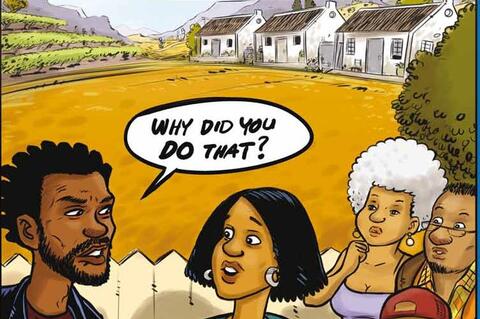
This project evaluates the use of drama to improve African adolescents' insight into tuberculosis (TB) and TB vaccine development, clinical research, and their rights and responsibilities as trial participants. As part of its community engagement for a phase IIb TB vaccine efficacy trial in almost 3,000 infants in the Worcester area of the Western Cape, the South African Tuberculosis Vaccine Initiative (SATVI) developed a comic - "Carina's Choice" [PDF] - which led to the decision by a local drama school to dramatise the comic in 2011 using high school pupils as performers, stage managers, and light and sound engineers. Described below is an initiative, carried out by SATVI in collaboration with the University of Cape Town Drama School and with Wellcome Trust funding, to build on this event by refining the production with the intention of rollout of the production to all Worcester area high schools from 2012-2013. The effectiveness of the intervention will be assessed by a social scientist with past experience in qualitative research in adolescents of this community.
This research-based project involves dramatisation of the comic, Carina's Choice, by pupils selected by their educators to participate in the drama production. This comic is available in the three main languages spoken in the area, namely English, Afrikaans, and isiXhosa. Performances will take place in at least 8 high schools in the area, reaching up to 5,000 adolescents. Video recording of the production will enable distribution through the Department of Education to other schools and through collegial networks to other clinical research sites in Africa. Pre- and post-intervention focus group interviews as well as pre- and post-performance knowledge surveys by attendees will form the basis for evaluation of the project. Parents and guardians will be informed by means of a take-home letter of the upcoming production and associated knowledge survey and given the opportunity to return a slip in order to "opt-out" of their child's participation in this survey.
To detail the process: GIPCA will first nominate a faculty member to sit on the production team and act as coordinator and supervisor of the students during the project. Senior drama students connected with GIPCA will provide guidance and coaching to the school pupils on script development, coaching of the performers, set and costume design, stage management, and sound and lighting advice. Film students will be involved in the video recording of the production. These GIPCA film students will also be responsible for the video editing and copying for further distribution. Contact between the pupils involved in the production and students will occur both at the schools and on the institution's campus in Cape Town. In this way, Worcester school children will be exposed to tertiary education campus facilities.
Performances of the production will be held first at 3 pilot schools; then, the final optimised product will be taken to the remaining 5 high schools in the area. The language used in the play will be a colloquial, slang Afrikaans, which includes English words and phrases. Use will be made of the school halls, if available, or local community halls. Copies of "Carina's Choice" will be distributed at the performances. The intention is reinforcement of the messages of the play and distributing the messages out into the wider community. The key messages in the production will be:
- TB is a problem, but the epidemic can be interrupted.
- There is a need for a new, more effective TB vaccine.
- SATVI is doing clinical research to test the safety and efficacy of new vaccines.
- Because clinical research involves testing new vaccines on people, there is a strong emphasis on safety and ethical conduct.
- Participants have rights in clinical research.
- The community's interests in research are represented by the Community Advisory Board.
Focus group interviews for pre- and post-intervention evaluation will be conducted by a social scientist at the 3 pilot schools, with each school's group meeting separately. The groups will be semi-structured with a pre-developed script but will allow for adaptation of content and duration according to the responses received. The pre-intervention group will help identify gaps in current knowledge and understanding and inform the content of the script. This group will thus meet during the early planning phase of this project when script development is taking place. The post-intervention group will meet within two weeks following the pilot performance at their school and assess the impact of the interventions on the group’s knowledge and understanding of TB and TB vaccine research. Focus groups will be audio and video recorded for transcription later.
Pupils forming part of the production will be encouraged to keep a record (i.e. a daily diary) of their experiences for evaluation, augmented by question and answer periods during the development of the drama production to unpack issues that arise as these adolescent "actors" engage with the script. This is designed to ensure that the development of the script has salient input from those similar to the intended audience. With the pupils' consent, the transcripts of these discussions and diaries will be used in the evaluation process.
In addition, pupil members of the audience will be asked to complete a pre- performance questionnaire to evaluate their knowledge of TB and clinical research, using validated survey questions. After the performance, they will be asked to complete a second, similar questionnaire, again to assess this knowledge and to seek comments on the value of the performance as a means of conveying a scientific message, its relevance, and its entertainment value.
Following the piloting, the production team will meet again to refine the script for further production. School teachers will be encouraged to initiate classroom discussions following the performance about TB and clinical research; if additional information is requested, SATVI will facilitate this.
Clinical research literacy will be increased in all pupils and teachers attending the production. Organisers "propose that this increased awareness and understanding of clinical research, TB and TB vaccine research will have a positive impact on recruitment processes in SATVI's proposed vaccine trials for this age group and on the volunteers' understanding of the nature of informed consent. For SATVI vaccine trials, the majority of scholars will be legal minors and will be giving informed assent with their legal guardian signing informed consent. The scholars who attended the performance will be better able to explain to their guardians why they should or should not participate in a vaccine trial. The choice of an adolescent not to agree to future trial participation will also be a more informed decision."
Video copies of the production will be made available to SATVI's collaborators in South Africa and within the Africa-wide TB Vaccine Sites Network (TBVACSIN; coordinated from within SATVI). The video recording may be adapted for new environments, following inputs from collaborators from these sites. Organisers will encourage assessments similar to that used in the pilot phase and will make our questionnaires available for this purpose. Video copies will also be distributed to the Department of Health as an educational tool for use in the Life Orientation programme.
At the end of the project, findings will be shared first with the participants in the drama production, focus groups, and the teachers involved. A manuscript will be prepared reporting on the roll out of the project and the findings of the focus group discussions and knowledge surveys and submitted for publication. Suitable conferences or meetings will be sought at which these findings can be presented.
Immunisation and Vaccines, Youth, Research
According to SATVI, modelling studies have shown that effective vaccination strategies should interrupt transmission of Mycobacterium tuberculosis. Adults and adolescents with lung disease spread the TB bacillus; therefore, adolescents are one of the primary target populations for new tuberculosis vaccination strategies.
SATVI has been conducting clinical research (intervention trials) in the Worcester area since 2001, which have included 12 trials of 5 novel TB vaccine candidates. As of 2012, they have enrolled more than 20,000 participants in such studies. This region is semi-rural; with a TB incidence of 1445/100,000 in 2007, this area has one of the highest rates of TB disease in the world.
SATVI states: "Trialists have an ethical obligation to engage the local community in research activities and to build community capacity in understanding and providing input into our research. SATVI's work with community stakeholders includes the establishment of a Community Advisory Board....Since adolescents are key targets for TB vaccine trials, it is important for them to be fully informed about TB, clinical trials and their rights and responsibilities with respect to clinical research. This study will evaluate innovative approaches to achieving these goals."
SATVI and the University of Cape Town Drama School, with funding from the Wellcome Trust. "Carina's Choice" was developed with a small grant from the World Health Organisation (WHO) for use in public engagement.
Wellcome website, November 8 2012; and emails from Michele Tameris to The Communication Initiative on November 6 2012 and March 22 2013.
- Log in to post comments