










































Door-to-Door Immunization Strategy for Improving Access and Utilization of Immunization Services in Hard-to-Reach Areas: A Case of Migori County, Kenya
Afya Halisi Project (Shikuku, Muganda, Amunga, Matete, Kisia); Department of Health, Migori County (Obwanda, Muga)
"A mobile immunization strategy underscores the importance of community-driven approaches to improve the access and utilization of immunization services."
Inequities driven by differences in place of residence and socio-economic status persist among different communities, hindering the achievement of sustained performance on immunisation indicators. Community-based Reach Every Child (REC) interventions at the sub-county and county level are among the "bottom-up" strategies deployed to reduce these local inequities. This study determines the effect of an enhanced door-to-door immunisation strategy on improving immunisation coverage in hard-to-reach areas of Migori, Kenya.
As explained here, REC has 5 key operational elements: re-establishing outreach vaccination services, providing supportive supervision to healthcare workers, linking services with communities, monitoring and using immunisation data for action and planning, and managing resources through microplans. Operationalisation of the REC approach contributed to increasing diphtheria-tetanus-pertussis (DTP3) coverage in Africa from 57% to 80% between 2000 and 2014. However, national county-level statistics show that Migori had a proportion of children 12-23 months fully immunised at just 37% in 2014. Some of the challenges in Kenya are related to difficulties with scheduling immunisation (hence, missed opportunities), knowledge gaps, inadequate capacity for storage of vaccines, myths and misconceptions around immunisation by the community, and economic barriers (faith-based organisations and private sector charging for immunisation services).
This was a cross-sectional review of District Health Information System 2 immunisation data for July and August 2018 for Migori. During the presidential immunisation rapid results initiative (RRI) in July 2018, poorly performing wards/facilities were mapped using the Quantum Geographic Information Systems methodology, and unreached rural-urban populations were identified. Through review of facility-level Kenya Expanded Programme on Immunization (EPI) data, 64 health facilities with over 100 unimmunised children each between January 2017 and June 2018 in all sub-counties were prioritised. In August 2018, intensified fixed-point immunisation services were offered within the prioritised facilities. Further, 3-day door-to-door defaulter tracing by community health volunteers (CHVs) and household-level immunisation by nurses were conducted. Immunisation coverage performance for access and utilisation for the 2 periods were compared using z-tests/t-tests.
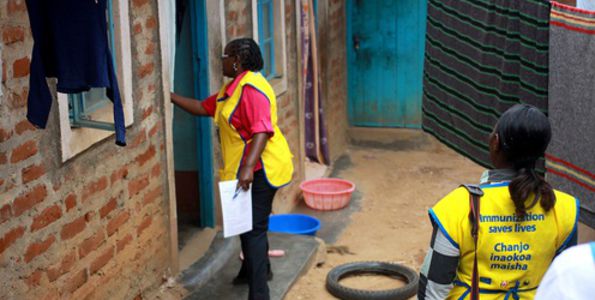
To highlight one particular component of the effort: Community mobilisation for the immunisation services was conducted by the respective CHVs, who provided households with information on the benefits of starting and completing all the immunisation services as per the prescribed Ministry of Health (MOH) schedule. Together with the vaccinator, the team moved from house to house, scrutinised Mother Child Health (MCH) records, the immunisation card, and/or the Bacille Calmette-Guérin (BCG) scar mark, and asked for the mother's or guardian's verbal verification to identify the unimmunised children. The CHVs had earlier received basic orientation on the MCH records. In areas considered vast, the team of CHVs mobilised all the eligible unvaccinated children to central points where the vaccinator would visit together with the Community Health Assistant (CHA) and vaccinate the children. Technical assistance was provided to the health records team to ensure timely, complete, and accurate reporting of immunisation indicators.
Overall, the findings suggest that the mobile immunisation strategy improved access to and utilisation of immunisation services among those in hard-to-reach areas. A total of 10,744 and 14,809 children were reached with immunisation in July and August respectively for the 64 facilities. There were significant increases in the immunisation coverage for BCG (74.4% vs 89.9%, P=0.0001), Penta 1(96.2% vs 102%, P=0.0649), Penta 3 (92.3% vs 112.1%, P=0.0001), measles-rubella, or MR1 (81.7% vs 111.5%, P<0.0001), and the fully immunised children at 1 year (78.6% vs 103.9%, P<0.0001).
As noted here: "Communication and community engagement are key elements of successful vaccine delivery....Community health volunteers are often relied upon by health facilities for communicating with the public regarding vaccination services....Advocacy with local traditional and religious leaders, information sharing with communities and building community mobilization networks with support from community 'gatekeepers' may help shed light on the felt needs of the communities and build trust between the community and the immunization program."
Concluding thoughts include: "Linking services to communities in the urban and social-economic hard-to-reach settings poses a challenge owing to the migratory nature of the population for survival. In addition, use of data to inform siting of mobile outreaches to reach target populations is a weakness identified in the facilities. The effectiveness of REC hinges on clear demarcation of the community to be served, its catchment population for mobilization, planning and monitoring. Use of facility immunization performance data to identify pockets in the community with unvaccinated/unreached children can inform where to invest the constrained resources to improve immunization coverage and maximize impact."
Finally, the researchers offer recommendations to improve immunisation services in areas with significant multiple hard-to-reach hotspots, such as: Counties should invest more resources in strengthening community health systems so that CHVs are motivated and retained to carry out demand creation and deliver community services, and that communities continue to demand and utilise health services - among them, immunisation.
BMC Public Health (2019) 19: 1064. https://doi.org/10.1186/s12889-019-7415-8. Image credit: Mummy Tales
- Log in to post comments