










































Developing a Gap Analysis Tool to Improve Ebola Vaccine Acceptance and Compliance in Sub-Saharan Africa
"Effective communication and community engagement to inform, interact and create a dialogue...could be the difference between high vaccine confidence, uptake and compliance and heightened vaccine concerns and mistrust, low uptake and compliance and even boycotts."
Experience in several sub-Saharan African countries has shown that, when a country decides to deploy an Ebola vaccine, careful attention to demand-side (community-level) preparedness is key to ensuring its success. To that end, the Ebola Vaccine Deployment, Acceptance and Compliance (EBODAC) Consortium has developed the Ebola Vaccine Communication, Community Engagement and Compliance Management (3C) Gap Analysis Tool to enable governments, in conjunction with other stakeholders, to assess preparedness to deploy an Ebola vaccine from a demand-side perspective.
The development of the 3C tool followed a consultative co-design process involving literature review, expert consultations, and simulation exercises.
The EBODAC Gap Analysis researchers began by conducting a literature review examining: global research and best practice on community engagement and compliance management in the context of the introduction of new vaccines; emergency vaccination programmes; and Ebola clinical trials and community-based responses. The review identified commonly used structures and layouts and frequent readiness themes.
Working in close collaboration with the ministries of health (MoHs) in Sierra Leone, Senegal, and Uganda, the researchers engaged in an iterative process of user-centric co-design in the development of the 3C tool that involved on-the-ground experts with first-hand experience of Ebola outbreaks and responses, vaccine trials, and community engagement. They set up multidisciplinary Project Steering Committees (PSCs) in each of the 3 countries; their early buy-in and feedback on user preference was considered vital to ensuring the 3C tool's acceptance and use once completed.
As part of the process:
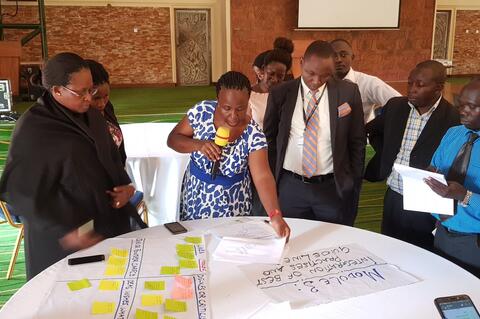
- 2-day co-production "jam" events (CPJs) were held in each country in November 2018 to bring together experts, innovators, policymakers, representatives from non-governmental organisations (NGOs), community leaders, and intended end users. The CPJs confirmed the findings of the literature review, generated new ideas and potential solutions, and flagged user preferences in the design of the C3 tool.
- In September 2019, government health officials, personnel from United Nations (UN) agencies, academics, and representatives from NGOs and the private sector gathered in Uganda for a 2-day guided simulation of the use of the draft tool. After testing, on the second day, users provided feedback, such as recommending development of a shorter tool for use in emergencies or by response managers who may not have sufficient time to complete the long tool. This has since been developed and utilised to guide community engagement for the vaccine trial in the Democratic Republic of the Congo (DRC).
Quantitative and qualitative data captured during these events were reviewed, analysed, and interpreted alongside other feedback, and incorporated into the final design of the 3C tool, which is intended to enable a country to assess its readiness to deploy an Ebola vaccine in both non-emergency and emergency scenarios. The tool outlines potential or desired performance in communication, community engagement, and compliance management and helps users measure their current performance against these benchmarks through a checklist and scoring system. Users can then create specific action plans or set performance targets. The tool has 4 modules:
- Module 1: Strategic 3C activities
- Module 2: Operational 3C activities
- Module 3: Integration of 3C best practices and guidelines
- Module 4: Supportive and enabling environment for 3C
Each module is broken down into 3 parts:
- Gap identification and scoring, which assesses readiness to implement 3C activities as countries plan for or are in the process of deploying an Ebola vaccine;
- A Prioritization Framework, which allows users to rank thematic and item-level gaps in preparedness; and
- Action Planning, which allows users to analyse gaps, propose solutions, and assign responsibility and timelines for putting new measures in place.
In Uganda, the 3C tool has enabled stakeholders to identify 3 priority Ebola vaccine 3C preparedness gaps:
- Preparedness for Ebola vaccination compliance management: In Uganda, it was found that systems for identifying and reaching population groups to be vaccinated were inadequate, and that no system was in place for monitoring population vaccination data. The EBODAC consortium is working with the Ugandan MoH to develop and maintain a database of priority groups to be line-listed for vaccination and to put procedures in place for monitoring who has and has not received the vaccine.
- Preparedness for gender and vulnerable groups: Anecdotal evidence from clinical trials in Sierra Leone points to the impact of gender inequality on vaccine trials; for example, some women were unable to participate in the trial when their husband refused to allow them to take necessary family planning measures. EBODAC will be supporting technical reviews of Uganda's preparedness plans, with a specific focus on addressing gender, family norms, inter-spousal relations, and family decision-making in 3C management plans. Attention will also be paid to identifying marginalised populations, including those living below the poverty line, elderly people, the disabled, migrants, and refugees, to ensure that vaccine deployment guidelines take into account their specific needs.
- Preparedness for messaging on an Ebola vaccine: Experience has shown that Ebola vaccine deployments cannot succeed without efforts to address community-level concerns and counter misinformation and rumours. Technical reviews are underway of Ugandan MoH manuals for community and stakeholder engagement, mass public communication, and interpersonal communication to ensure that key decisionmakers can identify appropriate channels and audiences for messaging, and that frontline staff have relevant guidance on effective messaging when engaging with individuals and communities. Furthermore, community-based qualitative research planned for 2020 in 6 study sites across Uganda will explore perceptions, beliefs, and attitudes towards Ebola vaccines among different population groups; the findings will provide baseline information for developing context-specific messages.
A shortened version of the 3C tool has been piloted in collaboration with key stakeholders in the Ebola outbreak response in the DRC. The initial results of this pilot have been used to generate a targeted communication and community engagement strategy to support a large-scale clinical trial of the Ad26.ZEBOV, MVA-BNFilo vaccine in Goma.
As of this writing, a digital version of the 3C tool is in development and is expected to be completed in 2020. Users will be able to sign in to a country-specific dashboard and complete the tool online, while simultaneously providing real-time analytical feedback on 3C preparedness in what the team intends to be an intuitive and user-friendly format.
Immunisation and Vaccines.
Between January 2014 and January 2016, 28,616 confirmed, probable, and suspected Ebola cases, including 11,310 deaths, were reported in Guinea, Liberia, and Sierra Leone. Another outbreak occurred in the DRC in 2019; as of December 26 2019, 3,366 cases (3,248 confirmed and 118 probable), including 2,227 deaths, had been recorded there. The outbreak in DRC puts neighbouring countries, including Uganda, Rwanda, Burundi, and South Sudan, on high alert.
Ebola vaccine projects - EBOVAC1, EBOVAC2, EBOVAC3, EBODAC, and EBOMAN - were launched in response to the 2014-16 outbreak in West Africa. It has become clear that reluctance and refusal can especially be an issue with Ebola vaccines due to the fear and stigma surrounding the disease itself, alongside mistrust of government, local stakeholders, and international organisations that often play a significant role in the deployment of Ebola vaccines.
The World Health Organization (WHO)'s Global Ebola Vaccine Implementation Team (GEVIT) Practical Guidance on the Use of Ebola Vaccine in an Outbreak Response: Draft Guidance, May 2016 [PDF] provides guidance on supply-side preparedness for deployment. However, it doesn't cover demand-side readiness in depth and thus does not enable governments or implementers to systematically assess their own readiness to deploy. This is where the development of the 3C tool comes into play.
"Developing a Gap Analysis tool to improve Ebola vaccine acceptance and compliance in sub-Saharan Africa", by Edward Kumakech, Maurice Sadlier, Aidan Sinnott, and Dan Irvine, Humanitarian Practice Network (HPN), March 2020; and World Vision Ireland website - both accessed on March 27 2020. Image credit: World Vision Ireland
- Log in to post comments