










































Design Preferences for Global Scale: A Mixed-methods Study of "Glocalization" of an Animated, Video-based Health Communication Intervention
Stanford University (Adam, Ward, Prober); Independent Researcher (Chase); Heidelberg University (McMahon, Bärnighausen); Johns Hopkins Bloomberg School of Public Health (McMahon); Stanford University Center for Health Education (Kuhnert, Johnston, Ward, Prober); Harvard T.H. Chan School of Public Health (Bärnighausen); Wellcome Trust's Africa Health Research Institute, or AHRI (Bärnighausen)
"Continually evolving health communication approaches and technologies present new opportunities for delivering health information to global audiences. This becomes increasingly important during global public health crises, when evidence-based health information needs to be communicated quickly across global regions."
Accessible health communication media interventions are increasingly recognised as strategies for increasing basic health literacy and promoting behaviour change. Prior research indicates the need for health communication interventions that not only accessible but also compelling to culturally and geographically diverse audiences. Socio-cultural considerations influencing message design, narrative, and visual elements require close attention when designing animated health communication interventions. This study presents feedback from global learners on animation design preferences and other key considerations for the development of educational video content - from the pilot of a South African video-based maternal child health (MCH) communication intervention - intended for global adaptation and scaling.
Developed in 2018, the pilot intervention was aligned with and intended to amplify the South African National Department of Health's existing, text-based national MCH education programme, The Road to Health. In designing the intervention, the researchers aimed to address four key challenges:
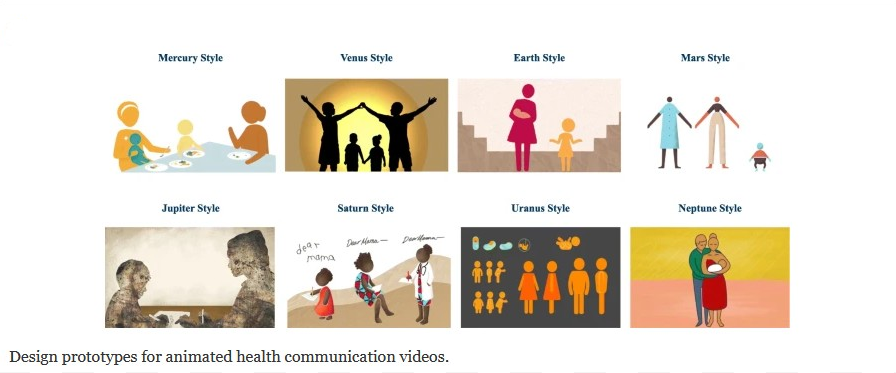
- To develop animation prototypes that were acceptable and compelling to culturally diverse mothers, fathers, and caregivers across South Africa, they intentionally avoided cultural identifiers such as hairstyles, facial features, and traditional clothing (per the theory of Universal Design for Learning). In designing the eight prototypes (see above), the researchers applied a human-centred design (HCD) approach, which involves iterative cycles of feedback from audiences and re-design by the development team. The earliest formative feedback was gathered in 2018 through interactions with the South African National Department of Health and a large community-based MCH organisation engaged in community health promotion.
- To avoid high data costs, they designed vector-based, two-dimensional animations compatible with small file sizes (2-10 MB) and optimised for mobile viewing.
- To overcome literacy barriers and to facilitate engagement and easy translation into different languages, they used a narrative, entertainment-education approach to motivate behaviour change.
- To facilitate future "glocalisation" (i.e., localised content created for a broad, global audience), they applied lessons learned from the children's entertainment-education industry - e.g., research documenting the glocalisation of Sesame Street by the Children's Television Network in the 1970s, which demonstrated the power of a structured approach to local language dubbing.
Following the launch of the intervention, the researchers received requests to adapt it for use in other global regions. To understand whether or not the eight prototypes would resonate widely, the researchers recruited participants from an international group of learners enrolled in a massive open online course (MOOC). Through an online quantitative survey (n = 330), they sought preferences from participants in 73 countries for animation design prototypes to be used in video-based health communication interventions. To learn more about these preferences, they conducted in-depth interviews with 20 of the participants. Interview participants were shown short video animations incorporating the animation prototypes they had previously ranked in the online survey.
Across the design prototypes, Mercury was most commonly preferred, with 62% of survey respondents believing that it "would resonate very well for global learners", and 46% ranking it as the first or second most-preferred design prototype. Earth was the second most preferred. Respondents in some regions indicated different preference rankings locally compared with the design prototypes they expected to resonate globally. For example, in East Asia and Latin America, respondents frequently preferred Neptune, but did not anticipate it to resonate globally.
Generally, respondents were willing to accept animation prototypes that were free of cultural and ethnic identifiers and believed these to be preferable for globally scalable health communication videos. Diverse representations of age, gender roles, and family structure were also preferred and felt to support inclusive messaging across cultures and global regions. Familiar-sounding voiceovers using local languages, dialects, and accents were preferred for enhancing local resonance. Across global regions, narratives were highlighted as a compelling approach to facilitating engagement, and participants preferred short videos with no more than two or three health messages.
Based on the results, the researchers offer two sets of considerations that may help inform the development of future interventions:
- The degree to which visuals need to be localised for each audience: Localising the audio only can help to offset the relatively cost- and time-intensive process of customising visuals for multiple audiences. Care may need to be taken to ensure that social and familial roles are represented in ways that are varied enough to be inclusive of the broadest possible audience. Approaches to glocalisation include the addition of "cut-ins", or short segments of highly localised video content added strategically at specified points in the video. The thoughtful use of colour should also be considered - e.g., in terms of accommodating learners with differing abilities and enhancing the viewer experience on mobile devices.
- The degree to which voice and narrative need to be localised for each audience: Storytelling lies at the foundations of the human experience, and decades of research underscore its important role in education and health care. The use of narratives may, for example, be a powerful way to support the inclusion of audiences with limited literacy and those with rich oral traditions. The characteristics of the narrator need to be carefully considered and may vary by audience and content area. For example, harnessing the power of the child's voice, especially for relevant topics like MCH and nutrition, could be a way to increase engagement and overcome reactance towards behaviour change messages.
In conclusion: "By increasing the accessibility of evidence-based health recommendations, through the design of effective, quickly scalable health communication videos, we can begin to meet the needs of a diverse global community. The associated social responsibility for providing equitable global access to these tools demands thoughtful, theory-driven, and evidence-based communication approaches - ones that will engage and empower people from different global regions and backgrounds....Designing health communication interventions, from the outset, with the potential for glocalization may prove to be both an ethical and a practical approach to improving health communication around the world."
BMC Public Health (2021) 21:1223. https://doi.org/10.1186/s12889-021-11043-w.
- Log in to post comments