










































Demand Generation Activities and Modern Contraceptive Use in Urban Areas of Four Countries: A Longitudinal Evaluation
The University of North Carolina at Chapel Hill, Gillings School of Global Public Health, Department of Maternal and Child Health (Speizer), The University of North Carolina at Chapel Hill, Carolina Population Center (Speizer, Corroon, Calhoun, Lance, Guilkey), Harvard University Center for Population and Development Studies (Montana), International Center for Research on Women, Asia Regional Office (Nanda), The University of North Carolina at Chapel Hill, Department of Economics (Guilkey)
"This paper presents the midterm evaluation findings of the Urban Reproductive Health Initiative (Urban RH Initiative) programs, funded by the Bill & Melinda Gates Foundation, that are being implemented in 4 countries: India (Uttar Pradesh), Kenya, Nigeria, and Senegal."
Urban RH Initiative's programmes were implemented to address the RH gap in some urban centres between urban residents' having "better access to and use of health services and better health outcomes" and the urban economically poor tending "to have larger family sizes, have less knowledge of and access to family planning methods and service." The Urban RH Initiative's goal is to: increase modern contraceptive use by 20 percentage points in targeted urban areas, particularly among the urban economically poor. The key objective for which information was sought in this research was: "Develop interventions for creating demand for and sustaining use of family planning among marginalized urban populations."
The research focused on demand creation activities on "modern contraceptive use." Pages 3 and 4 offer tables on the key strategies used by country, including advocacy, demand generation activities, and supply side activities. The combined studies used the multivariate random effects logistic regression model to analyse longitudinal data on women that included: recalled exposure to messages; participation in activities such as community conversation, small group discussions, or outreach worker visits; and modern method usage at the programmes' midterm.
Examples by country with findings and recommendations include:
- Analysing television as a medium in Kenya and Senegal, "exposure to television did not have an effect on contraceptive use". Though exposure was high in Senegal, it did not lead to discussion or a usage increase. In Kenya, the main television programme, called Matatu Sema Kit, did not lead to increased contraceptive use, though it led to wide viewership.
- Radio programming in Nigeria and Senegal was expanded because it was found that lower exposure than television still led to more effective results.
- The India programme put greater emphasis on community health workers (CHWs) trained as peer educators, who did home visits and community outreach activities in slum areas, because results showed that women who recalled exposure through these messaging efforts were significantly more likely to use modern methods at midterm of the study. Other media were: radio, television, magic shoes, road shows, and street plays - the last three were not assessed due to use in only one city.
- Through the Kenya Urban RH Initiative (called Tupange), "exposure to Tupange leaflets and brochures was significantly associated with modern contraceptive use between baseline and midterm... and exposure to Tupange’s Jongo Love radio program was marginally significant." Posters and comic books were also used.
- "In Senegal, women who reported participating in at least one l’Initiative Senegalaise de Santé Urbaine (ISSU)-supported [in-country consortium partner organisation] community activity, comprising a community conversation, a small group discussion, or outreach worker visits, were significantly more likely to be modern method users at midterm than women who did not report participating..." Engaging and training religious and community leaders, community theatre, and radio and television programming were other methods used by ISSU.
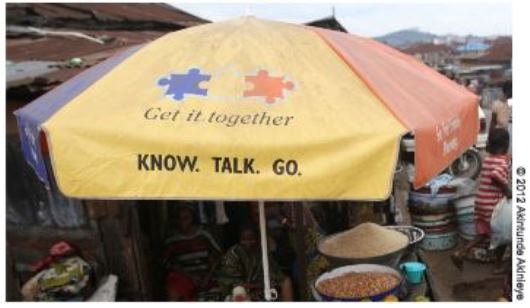
- "In Nigeria, through the Nigerian Urban RH Initiative (NURHI), women who recalled ever listening to local-language NURHI radio programs [and television programmes] were significantly more likely to be modern method users at midterm than women who did not recall listening to these radio program...", and "women who were familiar with the NURHI puzzle logo [and] slogan [see photo above] as part of the program branding, were also significantly more likely to be modern method users at midterm..." The logo was used on all materials and media, including television, signs at health facilities, umbrellas, and posters. Similar results were found with women who recalled receiving information at a community event, including association meetings, naming ceremonies, freedom ceremonies, graduation events, Christmas or Eid celebrations, and weddings.
For more information about the Measurement, Learning & Evaluation (MLE) Project or the Urban Reproductive Health Initiative, please click here.
Global Health: Science and Practice Journal of October 2014, accessed on November 7 2014, and email from Libby Bixby Skolnik to The Communication Initiative on November 12 2014. Image caption and credit: A roadside market umbrella in Mapo district in Ibadan, Nigeria, branded with the "Get it Together’" NURHI puzzle logo, encourages people to "know’" about family planning, "talk" with their partner about it, and "go" for family planning services. Akintunde Akinleye
- Log in to post comments