










































Dads Can Do That! Strategies to Involve Fathers in Child Feeding
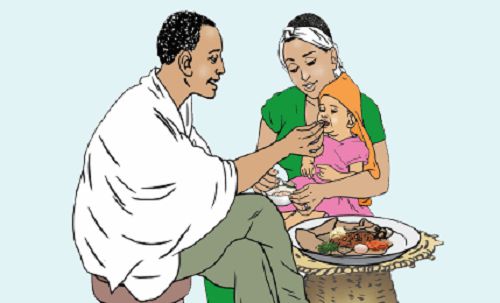
"Several recent projects have implemented innovative methods to reach fathers in culturally appropriate ways that both respect and challenge traditional gender roles. Initial results suggest that fathers' potential contributions to child health represent an untapped opportunity for realizing infant and young child nutrition goals and a healthy, productive future for resource-poor countries."
This case study from Alive & Thrive (A&T) shows how programme planners can use data to design interventions that engage fathers in feeding their children. It includes an introductory video, a literature review, and materials from A&T initiatives in Ethiopia and Viet Nam (see Related Summaries, below).
- The short video, below, on behaviour change introduces several strategies A&T recommends for helping fathers take actions for their children's health and development. It shows how fathers in Ethiopia go against tradition when they try their hand at cooking an enriched porridge. The viewer observes how a game-show style competition gives Vietnamese dads practice speaking up for breastfeeding.
- Featuring links throughout that lead to A&T programme activities and materials that may be tailored to each setting, an innovation brief [PDF] begins by offering a way to determine if a focus on fathers is right for your behaviour change campaign. Formative research, as was carried out in the A&T project in Ethiopia, can help assess 3 criteria: (i) Fathers in your community/culture could play a strong role in deciding how the baby is fed; (ii) Fathers would be willing and able to take some simple actions in support of breastfeeding and/or improved complementary feeding practices; and (iii) Fathers are easily reached through the channels you would use. The brief then introduces 6 strategies designed to ensure that a fathers' programme is more likely to change behaviours (examples from A&T interventions that engage fathers in child feeding are provided throughout):
- Use emotions - especially positive emotions - to draw fathers in. For example, this music video in Ethiopia features "beautiful visuals, smiling children, and a positive, can-do feel. It evokes emotion with words like "Let's not distinguish between father and mother. Let's feed him so we can celebrate the hope. A child's health is the country's health. Let him grow to be a light for generations."
- Ease the way by busting stereotypes. A&T in Viet Nam produced illustrated counseling cards [PDF] with images of fathers supporting their wives in feeding their children, which works subtly to help shift social norms. A cartoon image of a breast on a ceramic mug gets dads laughing and coming back to the clinic to request more mugs.
- Find fathers where they already are - both physically (e.g., tea rooms where they would gather to watch the Cricket World Cup (A&T Bangladesh) and in terms of knowledge and beliefs. For this reason, the Ethiopia mass media campaign is built upon analogies related to farming, in the hope that these will be meaningful to fathers. A TV spot to promote a varied diet links the value of giving baby a variety of nutritional foods with the farmer's value of rotating crops for a better harvest.
- Provide crystal-clear direction for actions fathers can take. As part of A&T Viet Nam, a specific and detailed list encourages fathers to take steps that support breastfeeding. It appears in the colourful brochure and on a large poster displayed at the clinic. The actions are also promoted in counseling sessions and during the men's contest. Formative research in Ethiopia helped A&T see that even in economically poor households, a few chickens may roam the yard. A TV spot encourages fathers to keep an egg to add to baby's porridge rather than sell all at the market.
- Give fathers practice. In the Viet Nam contest to promote breastfeeding, teams of fathers compete to see who can come up with the most supportive response to a scenario presented in a short video. In one scenario, a young husband comes home to find his wife wistfully trying to find a dress that will still fit her. She proposes that she will cut back on breastfeeding so she can fit into her clothes. What is a husband to say? That is the challenge fathers face in the contest – to offer a strong "ending" for the scenario.
- Show fathers a benefit they care about. Formative research in Ethiopia confirmed that the child's education and intelligence are a top priority for most fathers. A&T's community outreach activities in that country are promoted as "Smart & Strong Families". Fathers and mothers have a chance to earn a "Smart & Strong" certificate when they adopt the priority feeding practices.
- Published in October 2012, a literature review [PDF] explores 27 published articles on fathers' involvement in infant and young child feeding (IYCF) programmes. Its objectives are to assess the quantity and quality of information on fathers' current and potential actions to support improved IYCF and to highlight examples of interventions designed to involve fathers as a way to improve IYCF practices. In general, the researchers found that few studies have been done to gain an understanding into fathers' roles in IYCF and that fathers have generally been overlooked in IYCF interventions. Lessons learned include: "First, successful IYCF outcomes hinge on broadening the audience targeted with IYCF messages. This may include altering health system practices to include activities such as welcoming fathers' participation in prenatal and/or postpartum visits at which IYCF messages are communicated....Changing these practices and outlooks may change the way communities view child feeding, moving it from being a concern relegated just to women to being a concern for the entire community. Second, formative research is essential....Barriers to fathers' support for IYCF practices, including culture-specific gender roles, must be understood and may vary greatly from one context to another, even within the same country. Formative research also plays a key role in identifying the best locations, spokespeople, and communication channels for reaching fathers. Roadshows and workplace-based education are both examples of nontraditional settings for IYCF information sharing....Lastly, messages created to influence fathers' knowledge, attitudes, and beliefs must address the specific, feasible actions a father could take."
- Ethiopia: Fathers' involvement opens with some context for A&T's work in Ethiopia, indicating that "[f]athers may not think of feeding as something they influence, but when we bring the benefits to their attention, they say they want to help. For these reasons, many of Alive & Thrive's activities in Ethiopia are designed to engage fathers." It describes the "7 Excellent Feeding Actions" and mass media interventions that were developed, including a spot on complementary food variety. Links to all community and mass media materials are provided, such as to a music video in which popular Ethiopian vocalists issue a call to action for improved child feeding practices with a catchy tune and footage of the Ethiopian landscape and people.
- Viet Nam: Fathers' Involvement explores the challenge A&T faced in Viet Nam programming and the activities they undertook (e.g., messages about breastfeeding and about actions fathers can take to promote breastfeeding were promoted through posters, pamphlets, and local radio broadcasts of 10- or 15-minute entertainment pieces.) Links to print materials and interactive videos are provided. In 2010, A&T funded the Hanoi School of Public Health (HSPH) to conduct and study A&T as carried out in a region of Viet Nam. The study design is outlined, as are preliminary results. For example, for the knowledge item "knew breastfeeding should be continued when child is sick", the fathers who participated in the project (those in the intervention group) gained more knowledge than those who did not participate in the project's activities (the control). Similarly, for 4 of the fathers' actions the researchers asked about, more fathers in the intervention group said they were taking these actions (e.g., encouraged family members to support breastfeeding) than those in the control group. Finally, exclusive breastfeeding rates were higher in the intervention group than in the control group. To explain these results, A&T's use of behavioural theory is described (a diagram is offered). "With creative, emotional, and engaging activities and materials, a program can get fathers involved and, at least according to preliminary analysis of our data, can show positive associations between increased fathers’ involvement and better breastfeeding practices."
Email from Alive & Thrive to The Communication Initiative on October 21 2015.
- Log in to post comments