










































Contribution of Auto-Visual AFP Detection and Reporting (AVADAR) on Polio Surveillance in South Sudan
World Health Organization (WHO) South Sudan Country Office (Tegegne, Maleghemi, Bakata, Kibrak, Berta, Ndenzako, Olu); Ministry of Health, South Sudan (Anyuon, Legge); WHO Regional Office for Africa (Ticha, Pascal); Inter-Country Support Team (Manyanga, Bello)
"...study demonstrated that AVADAR could overcome the logistical and distance barriers that can impede the early detection and reporting of cases in rural and hard-to-reach areas..."
Surveillance, which relies on timely detection and notification of acute flaccid paralysis (AFP) cases, has been proven effective in many countries that have eradicated polio. However, maintaining a high-quality AFP surveillance system is challenging in hard-to-reach and insecure settings. Most of the population in South Sudan lives in rural areas with limited access to health services amongst frequent population movement, displacement, and interclan conflicts. Auto-Visual AFP Detection and Reporting (AVADAR) is a mobile-based technological intervention deployed in areas with such challenges. This study examines the contribution of the AVADAR community surveillance system to the traditional AFP surveillance system in South Sudan, comparing this approach with other non-AVADAR-implementing counties and documenting lessons learned and best practices.
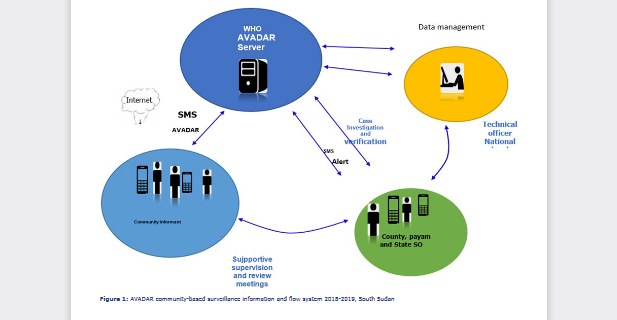
As explained here, community informants (CIs) use the AVADAR application (app) on Android smartphones to detect and notify suspected cases of AFP directly from the community. The app performs 4 operations: (i) case reporting via short messaging service (SMS) by the CI, as well as weekly zero reports; (ii) an automatic SMS generated by the server and sent to the Payam (second-lowest administrative division) surveillance officer; (iii) an automatically generated email containing the investigation's findings; and (iv) the saving of data, including the dashboard, to the server. In addition, the app has embedded video that becomes live every Monday at 11:00 AM. A video with a detailed description of an AFP case runs and asks whether there is an AFP ("Yes") and has not been reported or to confirm that the CI has not seen any AFP cases ("No") throughout the week. If the CI sends a "Yes" SMS with brief data, then the server will automatically trigger an alert to the cell phone of the corresponding Payam surveillance officer with a short description of the case. (The CIs use the running video also to conduct sensitisation of the community.)
Upon receiving notification, the Payam surveillance officer investigates and sends the result of the investigation to the server by filling out the necessary information using the Open Data Kit (ODK). Once the result is received, the server-generated SMS will automatically share the result of the investigation with all parties involved in the programme. If the case is a true AFP case, the county field supervisor collects and transports specimens per the national guidelines. The Payam officer and the national coordinator conduct supportive supervision and monthly review meetings in collaboration with county coordinators. For communication, a contract was made with each of the two cellular network providers (MTN and Zain) as appropriate to allow free voice communication and upload data. The Android phones are loaded with top-ups, data bundles, and a closed user caller group that enable cheap calls between the personnel involved.
South Sudan's AVADAR surveillance programme was established in June 2018 in 3 counties of Central Equatoria and Warrap states. This study used secondary AVADAR AFP surveillance data uploaded daily on the World Health Organization (WHO) AVADAR server between June 2018 and December 2019. All AFP cases detected and reported within the study period were included.
After 21 months of the pilot study, the number of CIs who were active and sending weekly zero reports remained at 234 (93%) of the initially trained CIs. All counties achieved the set target of 80% for timely reporting and 90% for completeness of weekly zero reporting, increasing in 2019 compared to 2018. The CIs made 578 alerts for suspected cases of AFP, of which 577 (99.7%) were investigated within 48 hours of notification by the Payam officers in all the project counties. Of those suspected cases, 56 (11%) were true AFP cases, contributing to 86% of the total AFP cases reported in the counties implementing the AVADAR surveillance system. Furthermore, over the study period, the CIs reported 567 cases of diseases of public health importance, including measles, meningitis, watery diarrhoea, malnutrition, and malaria.
In AVADAR-implementing counties, the average number of days between the date of onset and date of detection of cases was 5 days, compared to 8 days in the traditional surveillance system throughout the country. AVADAR-implementing counties showed a positive linear trend of the non-polio (NP)-AFP rate during the pilot. Non-AVADAR-implementing counties remained flat throughout the pilot. That said, within the project counties, the results are variable.
Reflecting on the findings, the researchers suggest that the high completeness and timeliness of zero reporting in this study may have been facilitated by adding a video app embedded in the AVADAR system. The video app automatically runs every week to remind the CIs to send weekly zero reports. Furthermore, the high reporting may be linked to close supervision, monitoring, and coaching of CIs on top of regular monthly review meetings. The high performance may have also been fueled by the presence of a fast SMS notification system by CIs and an automated alert system from the server to the Payam surveillance officers. It may also be simplified by the presence of a Payam surveillance officer in each Payam who investigates immediately once he receives an alert from the server, in which case communication, logistical, and access challenges are minimised, unlike in the traditional system.
Although many positive results were documented in implementing the AVADAR surveillance system, there were challenges in implementing the pilot. For example, poor network coverage in some study areas forced the CIs to walk long distances to areas where the network is good. Lack of power to regularly charge the phones and lack of other phone accessories were other issues. However, the staff made frequent follow-ups and immediate remedies to resolve these problems.
The researchers recommend expanding the AVADAR surveillance system to other poor-performing counties with similar challenges. However, before doing so, an in-depth baseline assessment should be conducted. They also suggest integrating other diseases of public health importance into the AVADAR surveillance system by incorporating locally appropriate tools that CIs can use during active surveillance, sensitisation, and reporting. This platform could also be scaled up to cover other child survival initiatives like immunisation (defaulter tracking).
Pan African Medical Journal. 2022;42(1):14. doi: 10.11604/pamj.supp.2022.42.1.33788.
- Log in to post comments