










































Community Health and Awareness Puppeteers (CHAPS) - Kenya
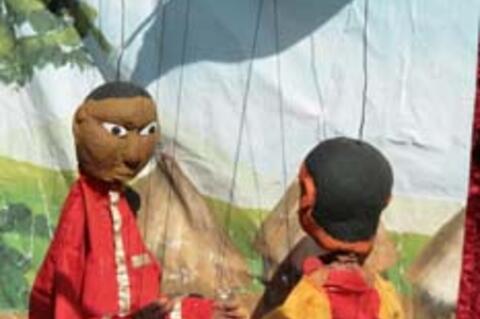
Festivals of educational puppetry, conducted in public places like parks, feature 20-minute stories rooted in the reality of Kenyan life. For example, one play depicts a rich man swindling poor villagers into paying for water they once collected free of charge; another involves a father trying to marry off his 14-year-old daughter.
Entertainment-education is a central component of the live puppetry performances that take place in the slums. CHAPS members beat drums, whistle, wave placards, and hit instruments in the tune of various cultural beats of the major communities that inhabit the slum to attract attention. Once the residents gather, they are grouped according to age and gender. Various types of puppets are used to deliver information to each category of audience about a particular theme such as HIV/AIDS, environmental conservation, drug use, gender, corruption, and human rights. CHAPS puppeteers also visit surrounding schools to disseminate messages.
CHAPS also conducts puppetry training with individuals and organisations involved in advocacy, community outreach programmes and social marketing. They offer two courses, a 14-day beginner’s course that includes sessions on message development and construction and manipulation of puppets. The second is a 21-day puppetry and folk media course that builds skills in drama, music, dance poetry, and storytelling in addition to puppetry. Planning, management, and leadership skills are also introduced.
Every 2 years, CHAPS hosts the Kenya International Puppetry Festival, which brings puppeteers from East and Central Africa, as well as the United States, Europe, and Asia together for performances, workshops, discussions, and exhibitions related to the use of puppetry in community education. First held in 2002, each festival focuses on a particular theme. The theme for the 2008 festival dealt with where and how puppetry fits within the theatrical milieu.
Environment, Health, Governance, HIV/AIDS, Gender
The Family Planning Private Sector (FPPS), an international organisation advocating for population control through contraception, brought puppetry technology to Kenya in the early 1990s. With the support of the African Research Programme (AREP), 2 FPPS employees trained in South Africa. CHAPS grew out of this training.
Organisers note that, in rural parts of Africa, many people are illiterate and have no access to radio or television. Puppetry builds on African performance traditions to entertain while it educates.
International Planned Parenthood Federation (IPPF); Ford Foundation; International Red Cross and Red Crescent Societies; Catholic Organisation for Relief and Development AID (CORDAID); Royal Netherlands Embassy; Department for International Development (DFID); Embassy of Finland; International Development Research Centre (IDRC); Prince Claus Foundation; Reuters; and World Bank
"Puppets Get People Past the Taboos" by Mike Crawley, Christian Science Monitor, March 19, 2002; and "Puppets Winning War Against HIV Spread" by Francis Ayieko & Meshack Nyaoke, Inner-Church Coalition on Africa - Kenya - News May 2000 and FPPS/CHAPS website on October 17 2008.
Comments

- Log in to post comments