










































Community Capacity Enhancement-Community Conversation (CCE-CC): Lessons Learned about Facilitating Positive Change in Communities Through a Local Discussion, Planning, and Action Process
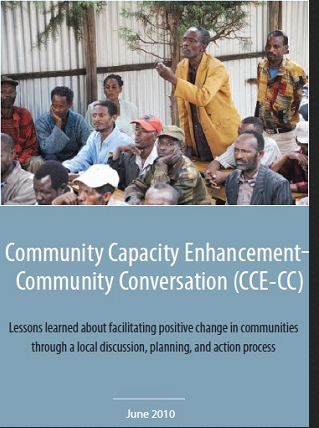
This report details the experiences of FHI 360 and its partners in Ethiopia in implementing the methodology known as Community Capacity Enhancement through Community Conversation (CCE-CC). CCE-CC was introduced into FHI 360 programming in 2006 with a focus on supporting the Home and Community-based Care Program (HCBC). FHI considers CCE-CC to be one of several methodologies that should be used within a comprehensive behavioural intervention. In this context, CCE-CC specifically addresses the creation of an enabling environment for behaviour change at the community level.
As a technical assistance agency, FHI 360 works to build the capacity of government institutions and civil society organisations to provide an expanded and comprehensive response to HIV and AIDS throughout the country. FHI focuses on areas where there is unmet need and where interventions will contribute to improving the public health and social welfare of the population. The CCE-CC methodology was incorporated into the home- and community-based care (HCBC) programme as a way of enhancing and strengthening their work to improve behavioural practices to prevent disease, encourage people to seek treatment when needed, and engage communities for change.
CCE-CC is a collective learning process designed to enable and strengthen community decision making and action related to HIV and AIDS and other issues affecting the community. It is important that CCE-CC is not seen in isolation but considered as part of a comprehensive behavioral intervention, where CCE-CC specifically addresses the creation of an enabling environment for behaviour change at the community level. CCE-CC is a participatory process that focuses on building the community’s capacity to assess their sociocultural, demographic, and economic conditions that contribute to HIV and AIDS and related problems, such as discrimination, stigma, and care for OVC. The process mobilises communities through facilitated dialogue to identify their concerns within the framework of their culture, values, norms, and traditions and then prioritises them according to their magnitude, severity, feasibility, and other criteria.
The process includes a clear set of phases that must be completed in order. The typical time necessary for completion of all of the phases is 9 to 12 months (approximately 18 to 24 sessions) requiring significant time to promote participation, reach consensus, and implement action plans.
- Relationship Building - The first phase of the CCE-CC process is relationship building. This is the time for the CCE-CC members to get to know one another and construct relationships built on mutual trust. The facilitator works to gain the trust and confidence of all members and establish expectations.
- Concern Identification - The concern identification phase incorporates several tools and activities to assist the CCE-CC groups to identify and select the key areas of concern for their community. One of the exercises for this phase requires CCE-CC groups to walk through their community catchment areas and map out community concerns. The mapping exercise also involves identifying key community resources, such as government offices, health clinics, schools, religious facilities, and other support services, which are labeled "green grasses". Groups also map high-risk areas and label them "red grasses". The process of identifying community concerns takes significant time, as the group must be given the opportunity to explore all of their shared concerns.
- Concern Exploration - This phase analyses and prioritises the concerns identified in the first phase. The facilitators help the group reach a consensus about the top three to five concerns and prioritise them. During this concern exploration phase, group members are encouraged to explore the magnitude of each concern and to examine the underlying factors that led to the concern. During this process, all of the groups interviewed as part of the review process unanimously selected HIV and AIDS, stigma and discrimination suffered by people living with HIV, and care and support of orphans and vulnerable children as their top concerns.
- Local Capacity and Resource Identification - After a group prioritises its concerns and identifies the factors that led to them, it identifies local capacity and resources to take action. Facilitators use specific activities to help the group during this process. Through a historical timeline analysis, group members discuss how they leveraged certain resources to solve past problems. The historical timeline analysis asks group members to reflect upon a challenging period for their community (e.g. drought) and review how the community dealt with the challenge or constraint, particularly with respect to the resources, leadership skills, and coping mechanisms utilised during that period.
- Planning and Decision Making- Once a group identifies local capacity and resources, members develop an action plan that involves decision making and the assignment of individual and group responsibilities required to address the concerns. As part of the action plan, the group includes all resources necessary and available to carry out the plan.
- Action (Implementation) - The action phase begins when community decisions are put into practice, and it requires CCE-CC members to mobilise support from other sources, such as the government, NGOs, community members, and religious institutions. The report recounts that three nurse supervisors in Nekemte noted that the action phase requires the most effort of group members, because in order to achieve action, they need to mobilise "resources, help from officials, and commitment of government."
- Review and Reflection - The review and reflection phase covers what has transpired since the first phase of the CCE-CC process. It involves participatory review, discussion, and identification of strengths and challenges, and it concludes with a validation of the results of the process. Ideally, this phase is an opportunity to reflect upon the experience of going through the process, as well as a chance to identify lessons learned that should be assessed when the process begins again.
According to FHI 360’s review of the methodology, interviews with key stakeholders provided valuable insight into how the CCE-CC has not only benefited and strengthened the HCBC programme but also resulted in an increased sense of community ownership and responsibility, decreased stigmatisation of and discrimination against PLHA and OVC, and improved water and sanitation quality. The process of CCE-CC itself (facilitating analysis of concerns, local resource identification, decision making, action to address the concerns, and reflection or review), has contributed significantly to members’ perceptions of their own concerns and their ability to effect positive change. Positive change is observed in attitudes related to HIV and AIDS, and there is a commitment to improve community-level responses to HIV and AIDS as well as other issues. The process has also strengthened the sense of community built on team work among the participants, idirs, and the wider community that benefited from the CCE-CC group efforts.
FHI 360 website on January 17 2013.
- Log in to post comments