










































Commitment to Practice: A Playbook for Practitioners in HIV, Youth and Sport
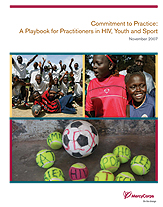
This paper, published by Mercy Corps, looks at the role of Sport for Development in HIV prevention. The document looks specifically at the role of "plus sport" programmes, as opposed to "sport plus" programming. Sport plus programming involves young people in sport to learn new sports skills and/or improve health and social integration. Here the outcomes are sport-related. The plus sport approach discussed in this document, on the other hand, has non-sport, HIV/AIDS-related outcomes as the primary objective. The document draws on the experiences of two plus sport projects run by Mercy Corps - Yes To Soccer programme in Liberia and the Sports for Peace and Life programme in southern Sudan - to discuss this approach and assess its value and limitations. Based on these projects, the document also offers tools and recommendations intended to contribute to developing a body of knowledge on practices within sport-based youth HIV/AIDS programming.
According to this document, Mercy Corps has utilised sport as a vehicle for complementing global humanitarian aid and development objectives for a number of years. However, only since 2006 has Mercy Corps looked to a sport-based approach to increase young people's HIV/AIDS knowledge and protective attitudes in a more rigorous way, coupled with an increased emphasis on comprehensive monitoring and evaluation.
The Yes To Soccer programme in Liberia and the Sports for Peace and Life programme in southern Sudan - implemented by Mercy Corps in partnership with Grassroot Soccer and supported by USAID and Nike Inc. - represent two examples of programmes that use the plus sport approach. This methodology uses community mentors to facilitate a curriculum designed to deliver basic HIV/AIDS information to youth participants. The curriculum uses Social Learning Theory and applies participatory games-based methodologies to impart HIV/AIDS information and life skills. Community mentors participate in a Training of Trainers (ToT) to build their skills as peer educators and mentors to facilitate the curriculum. Mentors then facilitate the participatory games, activities, and discussions with a group of approximately 20-30 youth from schools, sports teams, and other youth associations. After completing the curriculum, mentors and youth participate in graduation ceremonies and sports tournaments to celebrate their accomplishments.
According to this report, these 2 programmes have demonstrated that a sport-based approach and participatory games-based methodologies are effective in increasing youth HIV/AIDS knowledge and protective attitudes. Yes To Soccer reported a 27% increase in youth knowledge and attitudes from pre- to post-test (from 58%-85%). The programme was placed within an existing youth life skills programme targeting older youth. Sports for Peace and Life, while reaching a larger number of participants, showed a more moderate 12% overall increase in youth knowledge and attitudes (from 69%-81%) across 16 HIV/AIDS related questions. High knowledge and attitude baselines were observed on a number of pre- and post-test survey questions. This may have led to lower overall knowledge and attitude gains due to a “ceiling” effect that limited the degree to which the percentage could increase. The report points out that the duration of each programme was under one year and that longer programmes would provide greater opportunity to address and evaluate behaviour change.
Based on lessons learned through these two programmes, the document makes the following recommendations:
- Plan for adequate time on the front-end to conduct a comprehensive assessment prior to implementation, and on the tail-end to ensure that knowledge, attitude, or behaviour change can be measured.
- Embed plus sport programming in viable youth-serving structures.
- Dedicate significant time and resources to identify or develop a theoretically-sound curriculum with games-based methodologies that mentors can facilitate with youth.
- Identify, recruit, and retain respected mentors and provide mentors with the support they need to succeed.
- Assess local HIV/AIDS preventive and treatment services and, where available, design programmes that encourage youth to utilise those services.
Mercy Corps website July 9 2008.
- Log in to post comments