










































Cinema Leo Activity Report: Raising Awareness on Hazardous Child Labour Using Participatory Mobile Cinema in Uganda
This 11-page project activity report shares the experience of the Cinema Leo project, which used community screenings of a film about child labour and forum theatre to raise awareness and encourage dialogue around child labour in two regions of Uganda. The pilot project was a collaboration between Tri-Vision Uganda and the International Labour Organization (ILO) through the International Programme on the Elimination of Child Labour (IPEC).
As stated in the report, "In order to eliminate child labour, there is a need to obtain the views of children, parents, local leaders, social services and the community." For this reason, the pilot project used entertainment education to bring everyone together into a space that would encourage reflection and dialogue. The project used a multi channel approach which included a stakeholders meeting, radio talk shows on the most popular local radio stations, mobile village drives, Forum theatre sessions, and screenings of the "Stone Cold" film, which is the story about a man who takes his children out of school to work in a stone quarry.
As explained in the report, on the morning of the screening, a stakeholder meeting was convened which brought together local government representatives, employer agencies, the media, civil society, and police, among others. At those meetings, ILO-IPEC shared the latest information, policies, and trends on issues pertaining to child labour and their specific interventions. This was considered important in order to begin to engage the focus communities in addressing harmful child labour practices.
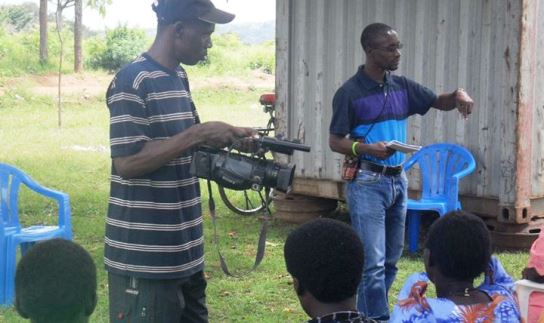
Along with the screenings, community members and leaders also participated in creating a short 5-7 minute skit to highlight the most pressing child labour issues in the project sites. These were later filmed, edited, and screened to the communities. The report notes that through this process, community residents identified a number of actions that should take place, for example, that children should stay in school, not be involved in the brewing or selling of alcohol, and the need to sensitive both employers and parents about not employing or assigning duties to children, especially on school days.
Prior to the screenings, people were mobilised through local radio stations and mobile village truck drives. The main evening event began with games and entertainment, followed by the screening and discussion of the movie "Stone Cold." The audience then watched the forum theatre skits which had been recorded earlier. After this, a discussion was facilitated with the audience. The report outlines some of the solutions agreed upon by the community. Overall, "the discussants confirmed that all the issues raised in the film and the drama are prevailing in their areas and that parents, guardians and local leaders should work together to curb child labour in their villages."
Based on the experiences, the report offers recommendations around the stakeholder meetings and the forum theatre events, which were largely logistical. For example, the report cites the need to separately mobilise people for the forum theatre and the stakeholders meeting so the two can run concurrently, the need for a local interpreters, and the importance of separate but close venues for the theatre and meeting.
The report also outlines some of the successes of the screening. Generally, there was great enthusiasm by the local partner agencies and the communities, and some communities requested to have the shows expanded to other sub counties in the two pilot districts. The majority of those who watched the film found it engaging and believable and they could relate with the messages that the film carried. They also liked the fact that they could watch themselves on screen for the forum theatre screening, and also enjoyed the village "sights and sounds" video recording, which was shown at the end of the screening.
International Labour Organization website on December 10 2014.