










































Changing Maternal, Infant and Young Child Nutrition Practices through Social and Behaviour Change Interventions Implemented at Scale: Lessons Learned from Alive & Thrive
RTI International (Flax); Alive & Thrive (A&T), FHI Solutions (Bose); University of North Carolina Charlotte (Escobar‐DeMarco); University of South Carolina (Frongillo)
"A&T developed and implemented at-scale MIYCN SBC in multiple countries, providing lessons learned about intervention strategies, engagement of influencers and mass media campaign development, which governments and other implementers can adapt and replicate."
Alive & Thrive (A&T) is a global initiative designed to advance the implementation of maternal, infant, and young child nutrition (MIYCN) social and behaviour change (SBC) at a large scale. Although A&T SBC has been evaluated in individual countries, the initiative has not compiled lessons learned from its SBC activities across countries. Therefore, this paper documents learnings about A&T SBC design and implementation processes, the impact of A&T SBC on specific MIYCN practices based on completed evaluations, and experiences from A&T's implementation of SBC at scale that may be useful to other implementers within the broader nutrition community.
As outlined here, the main goal of A&T is to implement SBC interventions at scale and generate evidence about scaled context-specific models, effectiveness, and implementation processes in diverse settings. A&T's first phase, from 2009 through 2014, was designed as a proof of concept that infant and young child feeding (IYCF) interventions could be delivered at scale and with impact in three countries (Bangladesh, Ethiopia, and Vietnam), each representing different cultural, economic, and health contexts. Beginning in 2014, A&T expanded to include India, Burkina Faso, and Nigeria. In May 2017, A&T was awarded a 5-year agreement, called Generation 2, which covered activities in Bangladesh and Burkina Faso and in Southeast Asia and West Africa, where A&T worked with stakeholders regionally to replicate strategies tested in initial countries within those regions.
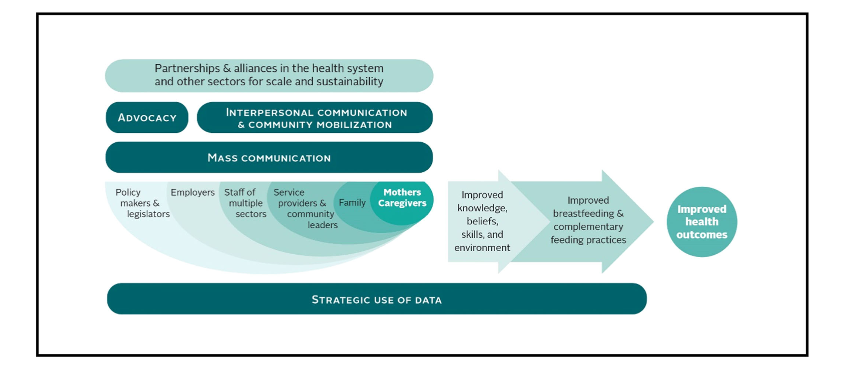
This study focuses mainly on the interpersonal communication, community mobilisation, and mass media components of A&T's framework, which make up A&T's SBC approach, and it touches on advocacy and strategic use of data as it relates to SBC design and implementation. The methods used were a desk review of A&T documents and 23 key informant interviews (KIIs) with A&T staff and stakeholders in Bangladesh, Burkina Faso, Ethiopia, India, Nigeria, and Vietnam.
Details of A&T's specific SBC activities carried out through implementing partners in each country are shown in Table 1 of the paper. In brief:
- Interpersonal communication formed the bedrock of A&T's SBC activities. Across countries, A&T collaborated with governments, major community-based implementers (e.g., BRAC in Bangladesh), or both to support the provision of face-to-face interpersonal communication between mothers and facility-based health workers or community-based health workers/volunteers on a large scale. Interpersonal communication was offered individually and in groups and was provided at health facilities, in communities, or at women's homes, depending on the setting.
- The community mobilisation component of A&T's SBC approach was intended to reach a broader segment of the population, shift MIYCN social norms, and support interpersonal communication. Activities involved training or orienting different types of leaders, encouraging leaders to share messages using their platforms, and conducting group activities for mothers and key influencers, especially fathers/husbands and grandmothers/mothers-in-law.
- A&T used mass media to reach scale, create awareness, shift social norms, and contribute to behaviour change among the broader population and specific audience segments. The IYCF mass media strategies varied the most across countries, with the choice of media and intended audiences selected based on formative research and media habits studies. A&T also developed a variety of IYCF SBC materials (e.g., counselling cards, posters, leaflets, billboards, bus wraps, sermon guides, wall charts, social media materials, child feeding bowls); printed campaign materials were included in the maternal nutrition interventions in most countries.
A&T collaborated with external researchers to carry out evaluations and implementation research to measure intervention impacts on IYCF and maternal nutrition practices. The study designs, impact findings, and effect sizes are summarised in Table 2 of the paper. In brief, A&T's approach increased exclusive breastfeeding, minimum meal frequency of children, and use of iron and folic acid tablets by pregnant women, but it had mixed impacts on early initiation of breastfeeding and maternal and child dietary diversity. Multiple SBC channels and frequent contacts strengthened the impact of SBC on MIYCN practices.
Key lessons learned in all or multiple A&T countries are summarised, with illustrative quotations, in Table 3. A full list of lessons learned, including those that were specific to one or two countries, is found in Supporting Information: Tables. In brief, lessons learned included:
- With regard to interpersonal communication:
- Use existing large-scale platforms for interpersonal communication.
- Improve counselling skills of health workers.
- Deliver timely tailored messages.
- Provide health workers and community workers with physical SBC tools.
- With regard to community mobilisation:
- Identify and use a variety of existing platforms for community mobilisation.
- Engage trusted leaders and influencial people at different levels to share messages and to motivate other people to participate.
- Involve key influencers and decision makers, especially husbands and mothers-in-law.
- Be clear about the actions you want influencers to take.
- With regard to mass media:
- Use research to address underlying behavioural concerns and to maximise mass media reach and frequency.
- Leverage media professionals to create the media products.
- Make the messages appropriate for different regions, and translate them into various languages.
- Make the TV spots memorable, and include relatable, realistic characters.
- Make the campaign name memorable and meaningful to all intended audiences.
- Create a media-dark strategy for areas without TV or radio.
- Consider frequent airing of TV or radio spots to create more awareness and cover multiple time slots.
- Select a small number of messages, and divide them up into small, doable actions.
- Use talk shows or call-in programmes to create more awareness.
- With regard to SBC materials and messages:
- Use the same messages, images, and branding across SBC channels for reinforcement and consistency.
- Design pictorial print materials for low-literate audiences.
- Contextualise visual content and language in SBC materials.
- Adapt SBC messages for specific subgroups/segment your audience.
- Develop SBC tools for different users.
- Work with government and other stakeholders to create a standard set of SBC materials that are used by government and all partners.
- With regard to strategic use of data:
- Collect formative data as the basis for SBC design by pinpointing problem areas related to MIYCN behaviours and identifying geographic differences.
- Conduct a media habits assessment to design the mass media campaign.
- Collaborate with government to integrate SBC indicators into regular data collection for monitoring, quality improvement, and/or performance-based incentives.
- Use data to show impact or demonstrate proof of concept.
- With regard to systems strengthening, enabling environment, and sustainability:
- Prove to the government that the model works so they can advocate for funding.
- Identify champion/champions for smooth programme implementation and sustainability.
- Collaborate with and engage the government from the outset.
- Coordinate and partner with other stakeholders for sustainability, convergence of initiatives, and joint advocacy.
- Integrate SBC programming into government platforms, support implementation, then hand over.
- Advocate and support the government to develop policies that create the enabling environment for the desired practices.
In discussing the study's findings, the researchers note, for example, that none of the parts of A&T's model (i.e., interpersonal communication, community mobilisation, mass media, strategic use of data, and advocacy) were new, but A&T's innovation was designing and implementing these components of an SBC programme at scale so they had an impact across contexts in and between countries.
"In conclusion, the A&T initiative demonstrated strategies and best practices for implementing MIYCN at scale....Taking into consideration lessons learned, governments and their implementing partners should replicate the A&T SBC model in different countries and contexts, document further adaptations to the A&T model, and share them widely....MIYCN programmes should work to fill remaining gaps in knowledge by developing and testing implementation approaches that can consistently improve early initiation of breastfeeding and maternal and child dietary diversity at scale and by designing media that can cost-effectively and sustainably engage people over time."
Maternal & Child Nutrition 2023;e13559. https://doi.org/10.1111/mcn.13559. Image credit: A&T
- Log in to post comments