










































Causes of Short Birth Interval (Kunika) in Bauchi State, Nigeria: Systematizing Local Knowledge with Fuzzy Cognitive Mapping
CIET-PRAM, McGill University (Sarmiento, Andersson, Cockcroft); Centro de Investigación de Enfermedades Tropicales (CIET), Universidad Autónoma de Guerrero (Ansari, Omer, Andersson, Cockcroft); Federation of Muslim Women Association of Nigeria - FOMWAN (Gidado, Baba); Bauchi State Primary Health Care Development Agency (Gamawa)
"Promoting contraception is unlikely to be enough on its own to reduce kunika. The summary maps will help local stakeholders to co-design culturally safe ways of reducing kunika."
For people in Bauchi State, northern Nigeria, kunika describes a short interval between successive births, understood as becoming pregnant again before the previous child is weaned. They recognise that the practice is bad for children, mothers, and households, but it remains common. In collaboration with the Bauchi State government, this group of researchers is developing a culturally safe module about prevention of kunika to include in home visits to pregnant women and their spouses. To inform the contents of this module, they carried out participatory research in Bauchi, using fuzzy cognitive mapping to systematise local knowledge about the causes and prevention of kunika. This paper describes the methods and findings of creating and analysing the cognitive maps.
Fuzzy cognitive mapping is a flexible, yet robust, tool to depict knowledge of causal relationships related to an outcome of interest. The maps are directed graphs that use arrows to show participant assumptions of causal connections between factors (nodes) and the outcome. Participants indicate the strength of the causal links with numerical weights assigned to each arrow. The maps describe structures of shared beliefs of participants using everyday language. Subsequent application of fuzzy logic uses mathematical language to describe these structures as soft models of systems of concepts.
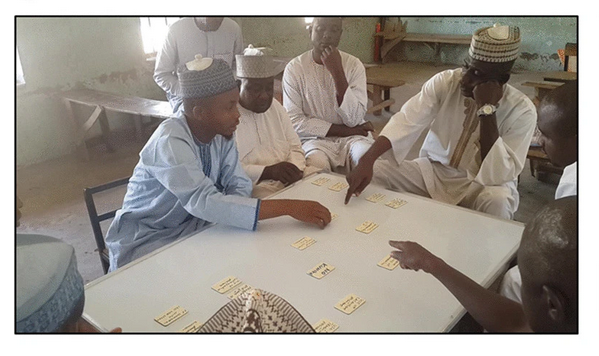
Male and female groups in 12 communities (97 women and 100 men) built 48 maps of causes and protective factors for kunika, and government officers from the Toro local government area (LGA) and the state made 4 maps. Each mapping session lasted about 3 hours. The facilitator wrote the outcome (kunika or no-kunika) on a magnetic tile placed near the middle of a metal whiteboard. The facilitator invited participants in turn to mention causes of the outcome according to their knowledge, writing each cause on a tile and placing it on the board. Many of the participants had limited or no literacy, and the facilitator read out what he or she wrote on each tile, and frequently reminded the participants about what was on each tile on the board. The researchers combined maps for each group: men, women, and government officers. To condense the maps, they grouped individual factors into broader categories and calculated the cumulative net influence of each category. They made further summarised maps and presented these to the community mapping groups, who reviewed and approved them.
The community maps identified frequent sex, not using modern or traditional contraception, and family dynamics (such as competition between wives in a polygamous context) as the most influential causes of kunika. Women identified forced sex, and men highlighted lack of awareness about contraception and fear of side effects as important causes of kunika. Lack of male involvement (e.g., men not being willing to use contraception or get advice about it) and not letting their wives get such advice) featured in women's maps of causes and in the maps from LGA and state levels. Maps of protective factors largely mirrored those of the causes.
The causes of kunika identified by women and men in Bauchi communities differ from those reported to be associated with short birth interval in quantitative studies in low- and middle-income countries. Age of the mother and education of the mother did not feature at all in the maps, perhaps because in the Bauchi context young age of mothers and low education of women are the norm, and do not explain why some women have kunika and others do not.
In short, the maps showed how kunika results from a complex network of interacting factors, with culture-specific dynamics. Simply promoting contraception alone is unlikely to be enough to reduce kunika. "This study demonstrates how communities can have a role in reducing kunika. The emphasis is not on knowing the true causes of kunika, but on supporting communities to identify what they know and what they can do to address the issue. Outputs of analysis of fuzzy cognitive maps can be made accessible to ordinary stakeholders, allowing their meaningful participation in interpretation and use of the findings."
Reproductive Health (2021) 18:74. https://doi.org/10.1186/s12978-021-01066-2 - sent from Anne Cockcroft to The Communication Initiative on September 21 2023. Image credit: CIET
- Log in to post comments