










































Case Study: SBCC Implementation Kit Helps Providers Address High-Risk Pregnancy in Togo
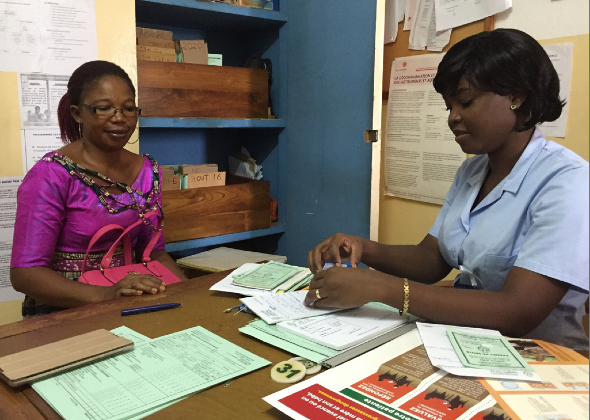
“Many found the project to be a wake-up call. They said they learned that they needed to better tailor their approaches based on, for example, age, parity, community norms and
behavior change theory.”
This case study looks at the results of a pilot project which involved using the healthy timing and spacing of pregnancy (HTSP) advanced maternal age (AMA)/high parity (HP) Implementation Kit (I-Kit). This is a tool developed by the Health Communication Capacity Collaborative (HC3) to help programme managers implement social and behaviour change communication (SBCC) activities that address the topic of AMA/HP pregnancy. The pilot project was implemented by the Association Togolaise pour le Bien-Être Familial (ATBEF), an International Planned Parenthood Federation member, in Togo.
The HC3 is a five-year, global project funded by United States Agency for International Development (USAID) to strengthen developing country capacity to implement state-of-the-art health communication programmes. Among other health areas, HC3 works in family planning on topics such as HTSP. As explained in the case study, “[G]lobal HTSP activities have focused largely on preventing closely spaced and early (i.e., before age 18) pregnancies. Much less attention has been given to the dangers of having too many pregnancies, or having children later in life.” In 2014, HC3 completed a desk review on knowledge and attitudes around AMA and HP pregnancy in low- and middle-income countries and an evidence review and secondary analyses of Demographic and Health Survey (DHS) AMA and HP Niger and Benin data. In 2015, HC3 conducted qualitative research and quantitative secondary analyses to understand the factors driving such risky pregnancies in Niger and Togo (see Related Summaries below). Based on this research, HC3 developed the HTSP AMA/HP I-Kit which includes a series of adaptable tools, including:
- a client brochure (one for less conservative audiences and one for more conservative audiences);
- a counseling and assessment guide for providers;
- a counseling and assessment guide for community health workers;
- a reminder poster for facility-based providers;
- a guide for journalists;
- a guide for researchers;
- AMA and HP infographics for policy and decision-makers; and
- a guide for working with community-based groups.
ATBEF was awarded $5,000 by HC3 to pilot the HTSP I-Kit, and from September 2016 to March 2017, ATBEF assessed the use of selected tools from the I-Kit in its main clinic, located in Togo’s capital, Lomé, and in four communities in Avé District.
As explained in the case study, “While ATBEF had extensive experience with information, education and communication (IEC) as well as behavior change communication, SBCC — which incorporates social norms and environmental factors into the health communication design and implementation process — was new to them.” The case study explains how ATBEF used the I-Kit to train service providers and Community Health Workers (CHWs), and to orient the management team and a Ministry of Health (MOH)/Maternal and Child Health Department representative on AMA and HP pregnancy. Training enabled providers to hold AMA- and HP-focused group education sessions with waiting clients and enabled CHWs to discuss AMA and HP during home visits and community discussions.
The case study highlights what worked well in using the I-Kit. For example, ATBEF found the I-Kit useful as it highlighted AMA and HP women as key audiences and offered a new perspective about the role of community norms in behaviour change. Staff also expressed appreciation of SBCC concepts such as engaging influencing audiences, since they had not included them in their work before. In addition as, clients and communities received the messages well, ATBEF has incorporated AMA and HP pregnancy avoidance in all of its provider and CHW training. Overall, pilot participants found the topics so valuable that they suggested sharing AMA and HP messages in all communities and health facilities.
Based on the pilot experience, ATBEF identified the following “lessons learned” and ways to adapt the I-Kit:
- Adapt the materials for low-literacy clients by replacing some text with picture.
- Develop materials, such as infographics, for delivering messages to large groups.
- Further simplify the counseling guides that would give health workers simple reminders of what information on AMA and HP issues and risk at a glance.
- Emphasize managing AMA and HP risks by highlighting the need for closer health monitoring with pregnancies after 35 instead of discouraging pregnancies due to age.
- Rethink “interactive” components - specifically those that offer questions for an AMA and HP risk self-assessment as women in Togo found this approach difficult to understand.
- Allow time for practice using new materials which would help health workers feel more prepared for real-life scenarios.
HC3 website on May 9 2017.
- Log in to post comments