










































BRACED Gender and Resilience Toolkit
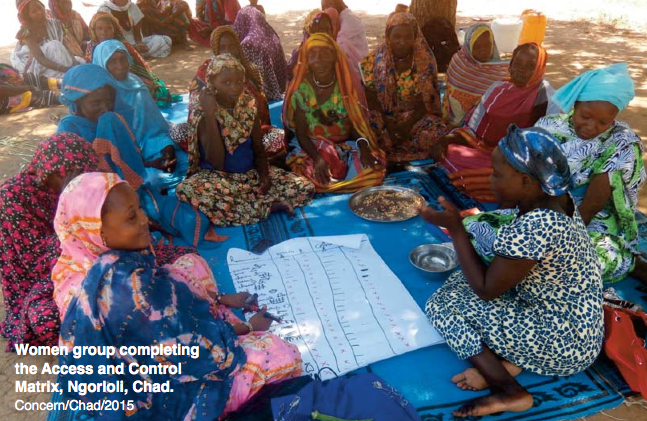
This toolkit consists of a set of three participatory tools that are designed to be used to ensure that programmes to build resilience and adaptation to climate extremes and disasters are taking gender issues into account. The activity tools - which include the Daily Activity Clock, Community Mapping, and the Access and Control Matrix - each present a different method to elicit and share information about the distribution of workloads, responsibilities, and resources as they relate to men and women. The tools are meant to sensitise community groups around gender norms, roles, and relations, and facilitate discussion around changes that can improve resilience.
The tools were developed as part of the Building Resilience and Adaptation to Climate Extremes and Disasters (BRACED) programme, which aims to improve the integration of disaster risk reduction and climate adaptation methods into development approaches. BRACED is being implemented by 15 consortia to build the resilience of sedentary and nomadic populations in 13 countries across Africa and South and South-East Asia. The Gender and Resilience Toolkit forms part of a project to improve community resilience through climate-smart agriculture, health, and early warning systems in Chad and Sudan, which is being led by Concern Worldwide.
The tools contains guidance for facilitators on how to run the different group activities and include sections on:
- Activity and Material Preparation
- Activity Steps
- Questions for Discussion
- Variation for Sectors (for example the Food, Income and Markets sector and the Water, Sanitation and Hygiene (WASH) sector)
- Facilitator Tips
The tools are as follows:
BRACED Gender and Resilience Toolkit - Daily Activity Clock: Tool No. 1 [PDF]
The Daily Activity Clock activity illustrates all the different kinds of activities carried out in one day. It is particularly useful for looking at relative workloads between different groups of people in the community, e.g. women, men, rich, poor, young and old. Comparisons between Daily Activity Clocks show who works the longest hours, who must divide their time for a multitude of activities, and who has the most leisure time and sleep. This knowledge can be very helpful during programme planning or evaluation to determine who should be reached out to by what activity and assess the potential and actual impact of a programme activity on beneficiaries’ workload. It can also be a powerful activity to bring to light unequal distribution of labour within a household or community and to encourage men and women to share work more fairly.
BRACED Gender and Resilience Toolkit - Access and Control Matrix: Tool No. 2 [PDF]
The Access and Control Matrix facilitates an analysis of women's and men's access to and control over resources. Often women might have access to an asset, such as land they cultivate, but not be able to make decisions on how to use an asset or even the products of it. By using the Access and Control Matrix for the assets and resources that the programme provides, facilitators can identify who should be involved and at what stage. It can be used to discuss gender issues in the community by bringing community members' attention to the constraints women face in managing assets and resources.
BRACED Gender and Resilience Toolkit - Community Mapping: Tool No. 3 [PDF]
Community Mapping is a common participatory methodology used across sectors to identify community resources, risks and hazards, and other things. During a gender analysis, Community Mapping can be used to a) identify differences between men and women in accessing communal resources and services, and b) identify risks affecting women and men in the community, which are often different. Comparing maps developed by groups of women and men can also help organisations understand different values placed on community resources by women and men. Community Mapping is a powerful visual tool, and it can be used to encourage community action to facilitate safe access to community resources by both men and women or to mitigate specific risks identified through the exercise. Maps can also be used as an advocacy tool with local leaders or authorities and, finally, they can be kept in the village to inform new arrivals or other non-governmental organisations (NGOs) of key resources, barriers to access, and risks.
Publishers
English
Concern Worldwide website and World Agroforestry website on February 14 2017.