










































The Big Read Africa
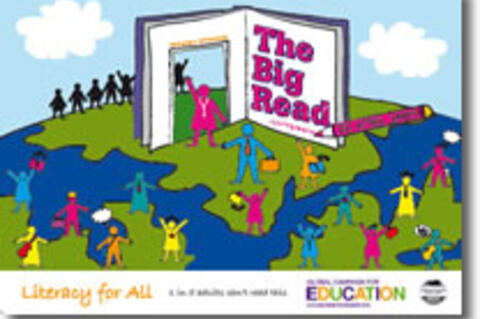
The global week of action centres around the The Big Read book which is a collection of short stories and poems, written by leading figures, Nobel Peace Prize winners, and award-winning authors, about education and the writer's struggles to overcome barriers to learning. The global book includes contributions from people such as Nelson Mandela, Desmond Tutu, Natalie Portman, Queen Rania of Jordan, Paulo Coelho, Ishmael Beah, Angelique Kidjo, Chimamanda Ngozi Adichie, Mary Robinson, Devli Kumari, Dakota Blue Richards, Michael Morporgo, Rowan Williams, and Beverley Naidoo. The book has been designed to inspire and motivate readers to campaign for education. Each country is invited contribute their own stories by well known people in that country.
Distributed in more than 100 countries free of charge to children, parents, and adult learners, readers were encouraged to log on to the campaign website to add their name to a declaration demanding that all governments make constitutional provision for every child to have a free, good-quality, public education. By holding a Big Read event, people were invited to join with millions across the globe, including Africa, reading the same stories and demanding education for all. After downloading the poster, stickers, and resources, people were asked to invite as many people (including politicians and local media) to gather to read the stories in The Big Read. By providing a register for everyone present, organisers could gather a list of names in support for EFA and then send it to the President or Prime Minister.
The Big Read events took place across the world, in homes, schools, government buildings, and in public spaces. According to the organisers, Big Read events in Africa included the following.
- Burundi: Activities and story collection in 17 provinces.
- Cameroon: Action Week was launched with a big ceremony, with hundreds of officials and civil society representatives. There was also a big ‘Big Read’ concert on April 22 in Yaoundé, with over 2000 participants and the football star ambassador Roger Milla.
- Democratic Republic of Congo (DRC): Over 1000 schools participated in The Big Read in 11 provinces.
- Ethiopia: The campaign focused on adult education – working with the Adult and Livelihood Education Thematic Group (Forum).
- The Gambia: Stories and testimonies from Gambia’s celebrities and learners were presented against a backdrop of songs on the theme of adult literacy written by trainee teachers.
- Ghana: The Ghana National Education Campaign Coalition organised various activities during Action Week.
- Kenya: Adult learners shared and read their stories at the Kibera District Commissioner's ground.
- Lesotho: The Big Read book was passed around civil society organisations and government departments collecting signatories in the book.
- Malawi: The campaign presented government with a new national education manifesto, spelling out what needs to happen in Malawi. Adult learners in rural areas compiled a dossier with evidence of how they can benefit from literacy, and how everyone having the chance of learning will contribute to the other ‘Education for All’ goals.
- Nigeria: The national education coalition conducted a media campaign across the country to raise awareness on the education of internally displaced people in five states.
- Sierra Leone: New ‘Education Watch’ research was launched.
- Somalia: The Big Read started with a media campaign on schools becoming violence free zones and a call to "aan ku biirno inta aqrida" (let’s join readers). Hundreds of universities and primary schools were mobilised to take part.
- Somaliland: Events included schools and centres using drama to motivate students, collecting stories on the success of literacy, and carrying out local surveys on literacy levels.
- South Africa – a new education movement was launched called Public Participation in Education Network (PPEN). PPEN took the Big Read to libraries and schools across the country culminating in an event on June 16, Youth Day in South Africa. Many South African authors contributed their stories to the Big Read book. Click here to view the South African stories.
- Swaziland: The campaign worked with the Swaziland Association of Librarians to host The Big Read story telling events in 15 centres across the country.
- Tanzania: Research was presented on youth and adult education to the government.
- Zambia: The Big Read Action Week ambassador is a female international boxing star, who has decided to go back to school. Esther Phiri is also a literacy ambassador, encouraging young people, as well as older people, to go back to school.
Education
According to organisers,:
- there are 33 million children out of school in Africa - the majority (18 million) of them girls;
- 50% of children up to the age of 12 in Malawi cannot read and write (even school going kids);
- two-thirds of all children arrive at primary school under-nourished or with a disability that will likely impair their education achievement throughout their lives;
- in Sub-Saharan Africa, 22 countries are offering secondary education to less than one-quarter of the school-aged population;
- huge gains have been made since 2000 in getting children to school, as school fees have been dropped in Kenya, Tanzania, Burundi, and other countries, yet this progress may be lost as a result of the global financial crisis;
- UNESCO predicts a drop in 20% per capita of Africa’s poor that will force the poorest countries to reduce their spend on education;
- UNESCO claims Mozambique, Ethiopia, Mali, Senegal, Rwanda and Bangladesh, to be most at risk; and
- the European Union’s aid commitment alone looks set to be $4.6 billion lower than in previous years.
Pambazuka website and Campaign for Education website on August 13, 2009.
- Log in to post comments