










































Bana Dukine (Kids, Let's Play!)
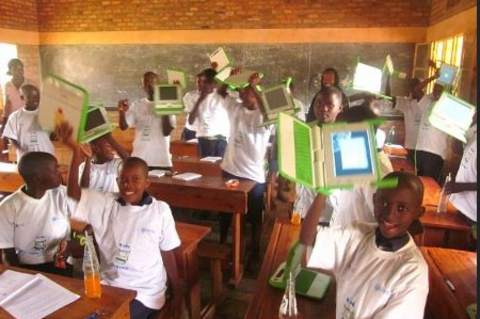
Launched in 2010, Bana Dukine (Kids, Let's Play!) is a computer game designed to teach Rwandan school children how to deal with conflict in their lives - what causes conflict and some effective ways to handle it. The game was developed by Search for Common Ground, in partnership with Serious Games, the United States Institute of Peace, and the Rwandan Ministry of Education, and is played on laptops donated by One Lap Top per Child (OLPC) programme.
Bana Dukine is set near a water hole and the characters in the game are the animals that use the water hole. The central character is Little Lion, whose father left him in charge of distributing water to the other animals. As the days go by, the temperature rises, and the amount of water in the hole decreases. This sets up the conflict between the animals over diminished resources. At this point in the game, conflict dialogues appear on the screen between characters, and it becomes the responsibility of little lion (i.e. the student) to choose the best response.
Bana Dukine is being used by students in the fourth and fifth grades, as this group is old enough to understand the message of the game and have the reading and computer skills to use the programme. The game is designed to complement lessons in the school curriculum.
During the testing and design phase of the game, SFCG spoke with a wide sample of Rwandan children to find out what types of situations and conflicts they typically experience in their lives. The conflict dialogues within the game are based on the feedback received. For example, in one scenario two of the animals fight over a soccer ball. In another, an animal feels left out because her friend did not include her to play together with the other animals.
Conflict, Education
SFCG conducted a preliminary evaluation of the game in 20 primary schools, conducting focus groups and interviews, and reaching over 400 students and 40 teachers in each province of the country. The evaluation sought to assess whether the game was appropriate for the students, if they learned new conflict resolution skills, and whether they could relate the lessons of the game to their real lives. Evaluations found that the game resonates with the children and that they, and their teachers, think it is a fun way to learn conflict resolution skills. Focus group discussions showed that the children had gained a high level of understanding of conflict resolution skills and, that the game provided a productive and safe space to learn and practice these skills.
Search for Common Ground, Serious Games, the United States Institute of Peace, and the Rwandan Ministry of Education, One Lap Top per Child (OLPC)
SFCG Update Newsletter, August 16 2012 and Common Grounf Blog on August 26 2012.