










































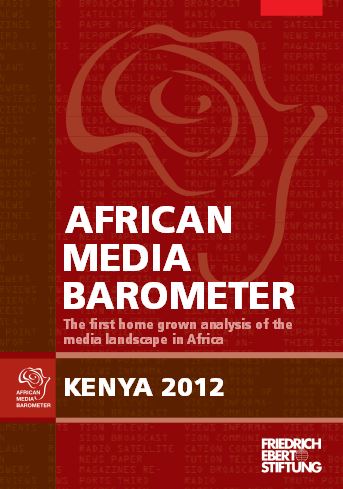
African Media Barometer - The First Homegrown Analysis of the Media Landscape in Africa
Image
SummaryText
The African Media Barometer (AMB) is designed to be an in-depth and comprehensive description and measurement system for national media environments on the African continent. The AMB is a self-assessment exercise based on criteria derived from African Protocols and Declarations such as the "Declaration of Principles on Freedom of Expression in Africa" (2002) by the "African Commission for Human and Peoples' Rights". The instrument was jointly developed by fesmedia Africa, the Media Project of the Friedrich-Ebert-Stiftung (FES) in Africa, and the Media Institute of Southern Africa (MISA) in 2004.
Reports are available beginning in 2005. Every 4 to 5 years, a panel of 10 to 12 local experts, consisting of at least 5 media practitioners and media experts and 5 representatives from civil society, meet to assess the media situation in their own country. For one and a half days, the panellists discuss the national media environment according to 39 predetermined indicators. The discussion and scoring are moderated by an independent consultant who also edits the country report, written by a trained AMB rapporteur following the AMB Panel discussion.
The AMB is an analytical exercise to measure the media situation in a given country. At the same time, it can serve as a practical lobbying tool for media reform. Its results are presented to the public of the respective country to push for an improvement of the media situation using the AU Declaration and other African standards as benchmarks. The recommendations of the AMB reports are then integrated into the work of the 19 country offices of the Friedrich-Ebert-Stiftung (FES) in sub-Saharan Africa and into the advocacy efforts of other local media organisations like the Media Institute of Southern Africa.
Reports are available beginning in 2005. Every 4 to 5 years, a panel of 10 to 12 local experts, consisting of at least 5 media practitioners and media experts and 5 representatives from civil society, meet to assess the media situation in their own country. For one and a half days, the panellists discuss the national media environment according to 39 predetermined indicators. The discussion and scoring are moderated by an independent consultant who also edits the country report, written by a trained AMB rapporteur following the AMB Panel discussion.
The AMB is an analytical exercise to measure the media situation in a given country. At the same time, it can serve as a practical lobbying tool for media reform. Its results are presented to the public of the respective country to push for an improvement of the media situation using the AU Declaration and other African standards as benchmarks. The recommendations of the AMB reports are then integrated into the work of the 19 country offices of the Friedrich-Ebert-Stiftung (FES) in sub-Saharan Africa and into the advocacy efforts of other local media organisations like the Media Institute of Southern Africa.
Languages
Reports are available in English, French, Portuguese, or all, depending on the country.
Source
fesmedia Africa website on April 18 2012, April 28 2013, and June 18 2014; and email from Nora Thoma to The Communication Initiative on June 17 2014.
- Log in to post comments