










































Her Farm Radio Initiative
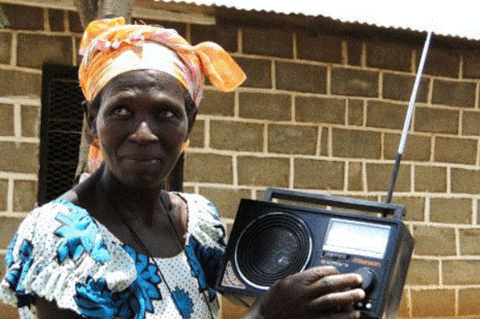
The Her Farm Radio initiative is a series of radio projects developed by Farm Radio International (FRI) which are designed to tune into the needs and wants of women farmers. Officially launched in July 2013, Her Farm Radio highlights projects that place particular focus on the voice and knowledge needs of women farmers and include projects that use radio drama, participatory radio, and reality radio programmes. The initiative is working in Tanzania, Uganda, Ethiopia, Malawi, Mali, Burkina Faso, and Ghana.
According to Farm Radio International, women farmers are the backbone of agriculture in Africa, involved in every stage of food production, from sowing and weeding to harvesting and selling crops at the market. Farmers, female farmers in particular, need access to relevant agricultural information to help them plan for and cope with change and to meet the nutrition and food security needs of their families and communities. Although an increasing number of female farmers in rural areas have access to mobile phones and radio, they still face specific challenges in accessing and using the relevant research, knowledge, and opportunities. The Her Farm Radio initiative recognises that women’s unique role in society must be met with programming that enables them to access, share, and interact with the information they need to increase food security for their families.
Her Farm Radio includes the following projects.
- The My Children Radio Drama: Broadcast in six languages by ten Ugandan radio stations, this 30-episode radio drama educates listeners about the nutritional benefits of the orange-fleshed sweet potato as the story's heroine struggles to nourish her family through her small plot of land.(see below for link to Related Summary for more information)
- Demand-Driven Participatory Radio Campaigns (PRCs): Though not exclusively directed at women, this project engages with women farmers in Ethiopia, Malawi, Tanzania, and Uganda, and asks them to express their specific information needs regarding nutrition and climate smart agriculture, and links them with the relevant research, results, inputs, services and markets. Through interactive PRCs, both male and female farmers are able to access information, evaluate it, pose questions, and listen to other farmers’ experiences. They are encouraged to make an informed decision to try the new technique—and they will be supported in its implementation. Based on past experience and research results, FRI projects that, through four PRCs in four countries, 250,000 farmers will gain deeper knowledge of one farmer-selected innovation and 100,000 will introduce it on their farms. This project is made possible through funding from Irish Aid.
- FarmQuest: This project seeks to encourage Malian youth, and young women especially, to consider farming as a livelihood through a reality radio programme that follows six contestants who are competing to be named "Mali’s best new farmer." Over six episodes, they will face tough decisions, weigh options, watch the skies, worry about their plants and animals, and negotiate with buyers. This concept was awarded the prestigious 2012 Innovation Challenge Award by the Rockefeller Foundation. Subsequently, the Foundation provided Farm Radio International with a $100,000 grant to bring the concept to reality.
- PASME (Project d’amélioration de la santé des mères et des enfants):FRI is working with one community radio station in Burkina Faso to engage local communities in active discussions on air related to maternal, newborn and child health, and to give women and their support networks the information and tools necessary to ensure a healthy pregnancy, birth and childhood for their children. PASME is a three year project being implemented with funding from Canadian International Development Agency (CIDA)'s Muskoka Initiative by World University Service of Canada (WUSC).
- CHANGE (Climate Change Adaptation in Northern Ghana Enhanced): Run in partnership with Canadian Feed the Children, this project provides tools and training to northern Ghana’s farmers, primarily women, to help them adapt to the increasingly severe effects of climate change in the region.
Food Security, Gender
FRI estimates that at least 75% of households in developing countries have a radio, making it one of the best ways to reach farmers across Africa. A recent study by the UN's Food and Agriculture Organization found that only 5% of farmers who use agricultural extension services worldwide are women. In Tanzania, approximately 55% of agricultural work is carried out by women, but only about 15% of extension workers are female. This can deter women from getting the information they need, especially when working alone in the field.
Farm Radio website on July 29 2013
- Log in to post comments