










































Zusha! Road Safety Campaign
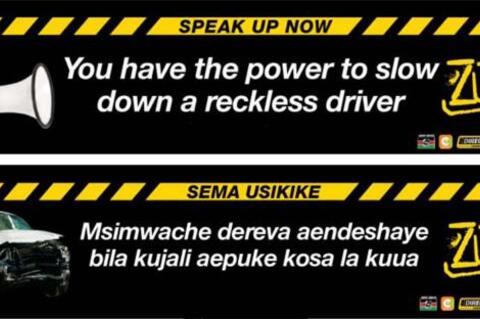
Launched in May 2015, the Zusha! National Road Safety Campaign aims to reduce road accidents by encouraging passengers using matatus (14-seater minibuses) or buses to speak out directly to their drivers against reckless driving. Zusha!, which is Swahili for “protest” or “speak up”, is being implemented in Kenya, with research trials taking place in Tanzania, Rwanda, and Uganda. The intervention is aimed at promoting agency among matatu passengers, empowering them to challenge the driver to slow down and drive less recklessly if they felt their safety is compromised. The campaign has three main components: 1) distribution of Zusha! safety stickers in the buses 2) complementary messaging through radio, billboards, social media, newspaper advertisements, editorials, and news articles, and 3) national and regional stakeholder conferences to raise awareness.
This scale-up of Zusha! in Kenya follows two successful research trials conducted by Professors William Jack and James Habyarimana of the Georgetown University Initiative on Innovation, Development and Evaluation, or gui2de. Between 2007 and 2013, results from two randomised control trials proved that the minibuses in which Zusha! stickers were placed had between 25-50% fewer insurance accident claims, translating into 140 avoided accidents and 55 lives saved annually. This success helped secure a grant from the United States Agency for International Development (USAID)’s Development Innovation Ventures (DIV) to scale up their intervention nationwide in Kenya and initiate research trials to Tanzania, Rwanda, and Uganda.
In the initial research phase, the project team, working with local partners and stakeholders, placed stickers in a random sample of more than 1,000 minibuses in Kenya and encouraged passengers to speak up when their bus drivers were driving recklessly. Now in its third phase, the campaign has expanded to include the following:
- Stickers - Stickers with evocative messages are posted inside matutus. They contain phrases like “don’t let a reckless driver get away with murder”, “you have the power to slow down a reckless driver”, and “don’t let a reckless driver cost you your job”. Drivers are encouraged to maintain their stickers though a lottery that randomly selects 8 matatus every week to receive a reward (the winning vehicle receives 15,000 Kshs in total, with the owner, the driver, and the agent each winning 5,000 Kshs). The sticker component is run in partnership with the insurance agency Directline. Every time an agent or an owner purchases insurance coverage, s/he receives an envelope with 4 stickers for matatus (if the vehicle has 14 passengers or less) and 8 stickers for buses (if the vehicle has more than 14 passengers). The total number of stickers distributed via Directline (as of June 2015) was 15,600. Distribution to public vehicles is also taking place through inspection centres.
- Billboards - By the end of 2015, the National Road Safety Trust sponsored 11 billboards placed across the country at dangerous black spots on country roads, and two in the Nairobi region. The billboards have 5 different designs in English and Kiswahili.
- Radio spots - 15 spots were broadcast of over six weeks.
- Television spots - Five television stations broadcast 30-second, 15-second, and 10-second Zusha! advertisements.
- Social Media - The campaign has been publicised through digital media. This includes: Facebook, Twitter, Google+, and a Zusha! website. Social media provides a platform where users can share their stories, inspire others to Zusha!, and submit reports about reckless drivers. It also includes a contest to share “your Zusha! moment”, where entrants can receive prizes. Twitter has been the most responsive in terms of engagement and reach.
Road safety
In sub-Saharan Africa, traffic accidents are the leading cause of death for children and young adults 15 to 29 and the second leading cause of death for children 5 to 14. Many of these deaths occur in minibuses or matatus, the primary mode of transportation in the region. The accidents cost the local economy billions of dollars a year. Often, accidents occur because of reckless driving such as speeding and dangerous overtaking. Solutions to this road safety problem, like speed governors, complaint hotlines, or increased traffic enforcement, however, can be extremely expensive. Such efforts also do not provide the passenger with the power to ensure their own safety at the moment of dangerous driving. For this reason, the Zusha! campaign was initiated.
Georgetown University Initiative on Innovation, Development and Evaluation, Development Innovation Ventures (DIV), Kenya’s National Transportation and Safety Authority (NTSA) and National Road Safety Trust (NRST), and General Motors and Directline Assurance.
Georgetown University website and Zusha! website on November 17 2016.
- Log in to post comments