










































Exploring Nurses' Experiences of a Tailored Intervention to Increase MMR Vaccine Acceptance in a Somali Community in Stockholm, Sweden: A Qualitative Interview Study
Public Health Agency of Sweden (Appelqvist, Jama, Roth, Godoy-Ramirez); Lund University (Appelqvist, Roth); Karolinska Institutet (Jama, Kulane); World Health Organization, or WHO (Lindstrand)
"The more knowledge I have, the more confident I am to engage in discussions." - nurse
Results from previous qualitative studies among parents in the Somali community in Rinkeby and Tensta, Sweden, showed that parents had low vaccine acceptance and delayed measles, mumps, and rubella (MMR) vaccination primarily due to fear that children would develop autism, despite lack of scientific evidence. As having an open and accepting approach is key in discussions regarding vaccinations, multicomponent tailored interventions were designed and implemented in 2015-2017 for two groups in Rinkeby and Tensta: Somali parents and child healthcare centre (CHC) nurses. This study aimed to explore nurses' experiences of an intervention that supported them with knowledge and tools to use during encounters and dialogue with parents with low vaccine acceptance.
The intervention was grounded in the WHO Regional Office for Europe's tailoring immunisation programmes (TIP), which is based on scientific evidence from social and behavioural science research and is underpinned by the Capability-Opportunity-Motivation-Behaviour model and the Behaviour Change Wheel framework. Based on findings of barriers and drivers, tailored and targeted interventions may be designed and implemented to support improved and equitable vaccination uptake.
The overall design and implementation of the intervention for both parents and nurses have been described in previously published research. (See Related Summaries, below.) The intervention activities for the 12 nurses working at the CHCs in either Rinkeby or Tensta included education and training, as well as a 14-minute narrative film with Somali role models and a 2-sided information card to use as tools when interacting with parents. The card consisted of key messages in the Somali language on one side with the same information on the other side of the card in Swedish. The key messages focused on: vaccinations offered free of charge for all children, the importance of childhood vaccination to protect against infectious diseases, and the need to vaccinate your child before travelling abroad. In addition, a link and QR code to the narrative film and a website with further information were included on the card.
In addition, during 3 consecutive weeks in August and September 2015, all 12 nurses were invited to a series of seminars. Each seminar lasted 2 hours and covered different topics relating to MMR vaccination, including how to use scientific evidence to debunk the link between autism and MMR vaccination, how to communicate with parents with low vaccine acceptance, and how to culturally tailor communication. At the end of the third and final seminar, the nurses were asked to participate in a short survey, the results of which were used to inform a guide for interviews that were conducted in November 2017 with 11 of the nurses.
The qualitative analysis revealed an overarching theme: perception of improved communication with parents. Two underlying themes were identified: (i) feeling more confident to address parents' MMR vaccine concerns and (ii) finding diverse tools as a useful support to dispel myths and reduce language barriers. For instance, nurses said that, after the intervention, they felt able to say with confidence that there is no scientific evidence for the vaccine to cause autism, whereas before the intervention, some nurses expressed feeling insecure and hesitated to vaccinate the child if the parents had low vaccine acceptance. Before the intervention, instead of engaging in a dialogue in such a situation, nurses just offered mothers the option of postponing the MMR vaccination.
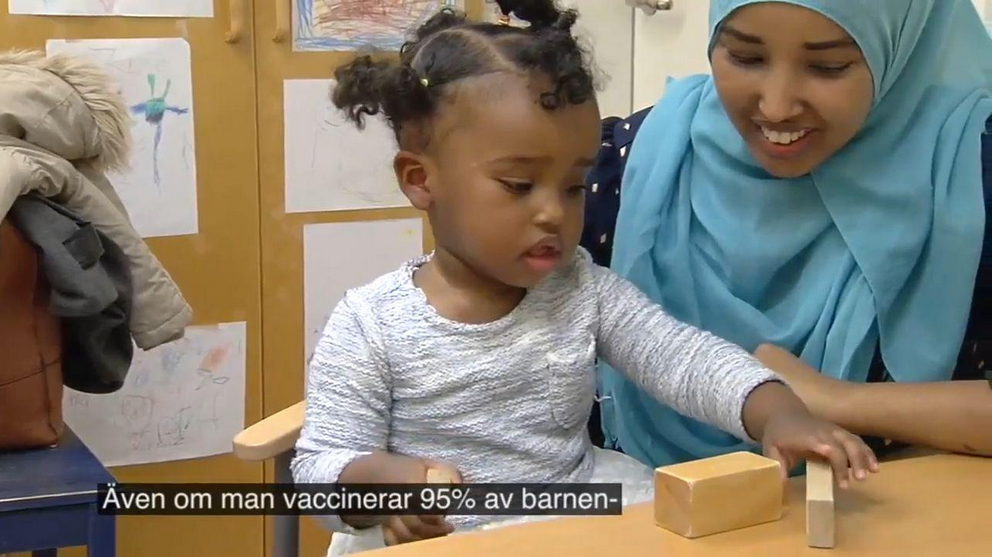
Nurses perceived the film positively, particularly since it was a visual tool and available in the Somali language, decreasing language barriers and facilitating a better understanding of the content. The experts featured in the film were reportedly well-known, trusted, and respected authorities in the community. At one of the CHCs, the film was shown on repeat in the waiting room so that parents could watch while waiting for their appointment. Nurses emphasised that the film helped parents to reconsider their decision for MMR vaccination; 5 of the nurses recalled and gave examples of situations where parents with low vaccine acceptance had changed their mind after watching the movie and chose to vaccinate their child against MMR.
Nurses described the usefulness of the card and how it had been helpful to hand it out directly to the parents. They particularly highlighted the link to the film and recommended parents to watch the film at home. Moreover, a stack of cards could lie on the nurse's desk, making it highly visible and easier to remember to hand it out. By handing out the card with information in both Swedish and Somali, the nurses knew exactly the content of the information they gave to the parents directly.
The nurses expressed that the seminars were beneficial and valuable. Gaining cultural insights as well as useful phrases to use in dialogue with parents were particular highlights from the seminar series.
Although the nurses described positive changes, there were still challenges in the dialogue with parents. An issue raised was the delicate balance between discussing proactively versus trying to persuade the parents. In challenging discussions with parents, the nurses did not want to feel like they were a salesperson for the vaccine or persuading the parents in their vaccination decision instead of enabling the parents to make a voluntary decision themselves.
Thus: "Findings from the present study suggest that tailored interventions with culturally tailored materials can facilitate nurses' communication about vaccinations with parents of Somali descent having low vaccine acceptance. From the perspective of the nurses, the tailored intervention using diverse tools supported the dialogue, dispelled myth and reduced language barriers while also giving nurses cultural insights. Importantly, nurses gained additional confidence in the scientific evidence supporting that MMR vaccination does not cause autism....In addition, tools were also useful during the outbreak of measles in 2017."
This study focused on the perspective of the nurses; further studies are needed to capture the perspective of the parents. The researchers also recommend assessing the long-term outcomes of the multicomponent intervention as well as vaccination coverage within the studied community.
In conclusion: "Nurses have a crucial role in vaccine uptake and acceptance. Interventions aiming to strengthen their communication with parents are therefore essential, especially in areas with lower vaccine acceptance."
BMJ Open 2023;13:e067169. doi:10.1136/bmjopen-2022-067169. Image credit: Public Health Agency of Sweden
- Log in to post comments