










































Tékponon Jikuagou Final Report
Georgetown University, Institute for Reproductive Health (Igras); University of California, San Diego (Lundgren)
"The results of the scale-up effectiveness study are startlingly good: the social network diffusion paradigm was highly effective in catalyzing community changes that created increased awareness, acceptance and use of modern family planning methods."
Efforts to reduce unmet need for family planning have historically focused on women (and, in some cases, their partners) without taking into consideration the social networks in which reproductive health decisions are made. Because these efforts have tended to fall short, public health practitioners have begun to use social network analysis as both an analytic tool and a theoretical paradigm in which to pose and answer ecological questions such as, How do peers' and religious leaders' words and actions influence individuals to seek family planning information? Tékponon Jikuagou is an intervention package, grounded in a social network diffusion approach to social change, that sought to alter social and gender norms in support of family planning in Benin. This end-of-project report details how the project worked and what its impacts are. It complements the other project resources found at Related Summaries, below.
The Institute of Reproductive Health (IRH) at Georgetown University, along with CARE International and Plan International and with funding from the United States Agency for International Development (USAID), designed, piloted, and scaled up Tékponon Jikuagou in Benin from late 2012 through early 2017. Specifically, the project passed through three key phases over its lifespan, each including monitoring, research, and learning activities:
- Design phase, prefaced by formative ethnographic research (learn more in Chapters 1 and 2 of the report);
- Pilot phase, in 90 rural communities of Couffo Department, accompanied by effectiveness, costing, and cohort studies (learn more in Chapters 3 and 4 of the report); and
- Scale-up phase, in 88 rural communities of Couffo and Ouémé Departments, by four new implementing ("user") organisations, accompanied by effectiveness, integration, organisational, capacity, and most significant change studies (learn more in Chapters 5 and 6 of the report).
Design of the Tékponon Jikuagou package was based on the hypothesis that social norms strongly influence reproductive practices, and that a social network diffusion approach, in tandem with communication for social change (CFSC), could harness social networks to spread information and ideas to influence those norms. This process, it was assumed, could re-shape family planning attitudes and practices through five linked components:
- Engage communities in social network mapping to identify the most influential and connected social groups and individuals;
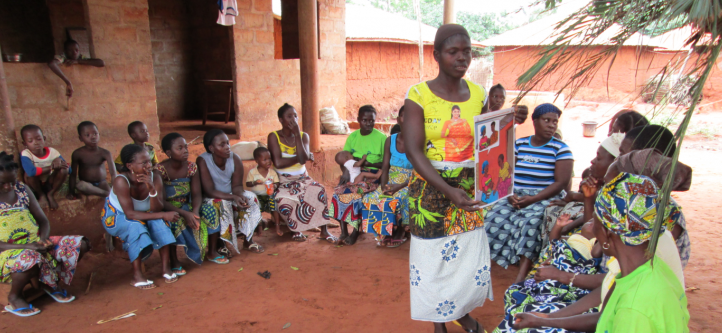
- Support influential groups in reflective dialogue about social and gender barriers to unmet family planning need and to foster ideas diffusion with family and peers;
- Encourage influential individuals to engage their constituencies on matters related to unmet need, thereby breaking down taboos to discussing them;
- Use radio to broadcast stories and group discussions, thereby extending the reach of new ideas and creating an enabling environment; and
- Link family planning providers with influential groups, allowing accurate information to flow through influential networks and encouraging individuals to seek information and services.
Evaluation of the 18-month pilot phase used a community-based, randomised control design in 45 of the 90 participating villages. Endline results showed positive and significant associations between Tékponon Jikuagou package exposure and family planning outcomes, including increased odds of modern method use among women and met need for family planning among men. Women who heard Tékponon Jikuagou radio were 1.5 times more likely than other women to talk with their spouse about the number of children they should have and 1.6 times more likely to talk about which family planning method to use. The effect of Tékponon Jikuagou radio on men and couple communication was even stronger, with exposed men 2.5 times more likely to talk with their spouse about what method to use and how to obtain the method than unexposed men. In short, the pilot results confirmed Tékponon Jikuagou's change theory, demonstrating that increased public discourse, spousal communication, and perceived social approval were associated with family planning use and met need.
The effectiveness study surrounding the 14-month scale-up phase, which used a slightly revised intervention package based on pilot study findings, involved multivariate analysis of participants' baseline and endline data. In brief, this study revealed strong, positive changes in method use linked to exposure to the Tékponon Jikuagou package, and it showed a significant association between participants' perception that their social network accepted and used family planning methods and their own use of modern methods and expression of family planning met need. Women exposed to select package components (e.g., interpersonal communication (IPC) in the form of group discussion and influential outreach, as well as radio) were 6-7 times more likely to use a family planning method and to meet their family planning needs. (Men were about 2 times more likely to do so.) At the endline survey of the scale-up phase, 60% of women were using a method of family planning, up from 38% at baseline and compared to 17% and 13%, respectively, in control communities.
Scale-up evaluation findings gathered from the four user organisations indicate the potential sustainability of Tékponon Jikuagou through such integration. For instance, staff from these organisations said they:
- valued the social network diffusion approach, contending that a focus on social norms and the use of reflective dialogue enhanced the host project(s) to which the Tékponon Jikuagou package was added and led to positive family planning results;
- found that the social network mapping component was a time-consuming investment up front, but it led to efficiencies during later implementation;
- felt that reflective dialogue and the theme of addressing unmet need could be integrated into and enhance activities and deliverables in host projects' programming on themes other than health; and
- were willing and able to incorporate the social network diffusion approach - and the topic of family planning - into their culture and ways of working.
In fact, new non-governmental organisations in Benin have begun to integrate the package into their projects, and champions are supporting Tékponon Jikuagou expansion in the country.
Chapter 7 of the report reflects on: theory, practice, and measurement; some lessons learned; and ways forward to support expansion and others' use of the social network diffusion and CFSC approaches in general, and the Tékponon Jikuagou package in particular. For example, implementation science (piloting) made a difference: Organisers made adjustments every six months using available evidence to guide decision-making, and they believe these iterative, participatory learning-reflection-action cycles led to crucial package improvements. Based on their experience, they recommend several strategies, including provision of resources by a global USAID project or other entity to allow strategic technical scale-up assistance in West Africa so that Tékponon Jikuagou is known, applied, and continues to expand within and outside of family planning programmes.
In conclusion: "The cumulative results of the pilot and scale-up phases illustrated that a programming approach using social network interactions can rapidly influence individual behavior. Tékponon Jikuagou's promising social network diffusion approach challenged us to think differently about the demand side of family planning programs, indicating that a light but strategic approach to behavior change via social norms change may be effective at achieving sustained behavior change at scale. Indeed, the results provided extraordinarily consistent confirmation that the package components, which included interpersonal communications and radio broadcasts, rapidly altered personal and social network attitudes and behaviors in profound and, it is to be hoped, lasting ways."
USAID archived content, accessed on July 11 2022. Image caption/credit: A facilitator leads a discussion with a women's group about couple communication, family planning, and acting on reproductive intentions. ©IRH
- Log in to post comments