










































Studio Live: Promoting Saharawi Voices Through Music
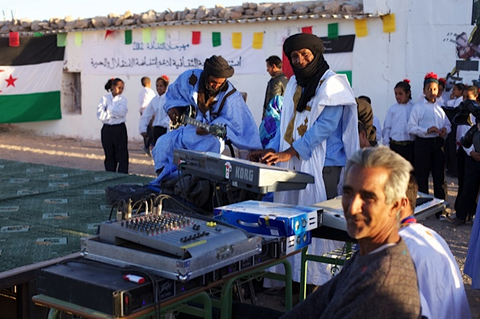
Launched in October 2010 by Sandblast, Studio Live is a 3-year project to facilitate the flourishing of a local music industry for artists in the Saharawi refugee camps in the Algerian Sahara. The project aims to create a means for the community to develop and gain a voice through music, as well as to preserve cultural traditions. The project activities focus on working with emerging music talent and encouraging the participation of women and youth. Working in close collaboration with the Saharawi Ministry of Culture and United Kingdom (UK)-based partners such as Fairtunes, Refugee Radio, SOAS Radio, and The Moringa Tree, Studio Live is designed to enable Saharawis to reach international audiences through their music, to promote their culture and their cause.
In 2007, Sandblast organised the first Festival of Saharawi Arts and Culture in London, UK, bringing together 20 artists from the refugee camps to participate and attracting over 2,500 people over three days. According to Sandblast, the 8-member band from the refugee camps, Tiris, which also toured 6 UK cities, made a huge impression, which led to the idea that music could be used as a medium to get global recognition for the Saharawis.
Studio Live project activities include the following:
- Professional workshops to build instrumental, artistic, and music-business skills. These workshops aim to provide a global understanding of the way the music industry works.
- Technical skills training through sound engineering workshops, both for recording and live.
- Creation of a mobile music resource library to make instruments and sound equipment available for rental to all Saharawis seeking to pursue their musical ambitions.
- Setting up and running a recording studio to meet professional standards. This studio will be a community resource and also support current efforts to record and preserve the threatened Saharawi oral traditions, envisioned by the mission of the International Observatory for the Protection of the Cultural Heritage in the Western Sahara.
- Stimulating international collaborations with Saharawi musicians and strengthening their ability to promote themselves through new distribution channels.
In September 2010, the Studio-Live team travelled to the camps for the first time to meet with the Ministry of Culture and establish a partnership with them for the project. This was the occasion when agreements were made to provide training for live concerts, as this was identified as a priority by the Minister, and also to assist in the equipping of the studio that would be set up in the new Saharawi National Music School (Enamus) that was being built in the camps. In March 2011, the team returned to do recordings of established and emerging Saharawi musicians, such as traditional music group Tahadi and new band Zeeza. A van full of sound equipment was donated by Sandblast-Fairtunes to be used in the training workshops.
In March 2012, the Studio-Live team spent 2 weeks in the camps and participated in Run the Sahara 2012 as part of the UK group that was raising funds for Studio Live. The trip included a cultural day organised by Sandblast, when all the runners could enjoy learning about Saharawi traditions and music with the group Salwan. They also interviewed different musicians across generations about their ideas, dreams, and aspirations, discussing Studio Live and the development of Saharawi music in the near future with them and gaining a better idea on the best way for them to take full advantage of the project.
Culture, Human Rights
According to Sandblast, Saharawi music is currently the artistic medium with the greatest potential to reach worldwide audiences and get the Saharawis on the cultural map. Rooted in Yemenite and West African influences, the music of this dispossessed nation has always played an important role in their society and been at the forefront of expressing their culture and struggle. Now, it is a symbol of Saharawi commitment to non-violent resistance and is vital to reinforcing their identity and oral traditions. According to local Saharawi sources, prolonged exile has led to the loss of more than 60% of their intangible cultural heritage.
Studio Live is being set up in the south-west corner of the Algerian Sahara, where close to 200,000 refugees are spread out over 5 large camps. Although they are entirely dependent on precarious flows of food aid for their survival, the refugees are also citizens of a nascent state in exile, the Saharawi Arab Democratic Republic (RASD). Each camp, known as wilaya, is named after one of the main cities of Western Sahara. They have their own administration, hospitals, cultural and youth centres, and schools. The Saharawi Ministry of Culture is responsible for the promotion and development of Saharawi culture. Each wilaya has its own recognised music bands, closely connected to the cultural or youth centres. Musicians are often called to participate in national celebrations and festivities. There are also many independent musicians who often provide music and entertainment for weddings and social occasions.
Sandblast, Saharawi Ministry of Culture, Fairtunes, Refugee Radio, SOAS Radio, and the Moringa Tree.
Sandblast website on July 4 2012; and email from Violeta Ruano to The Communication Initiative on April 19 2013.
- Log in to post comments