










































Reporting Tax Research: Connecting Researchers and Journalists for Improved Media Coverage and Debate in Kenya
PANOS London
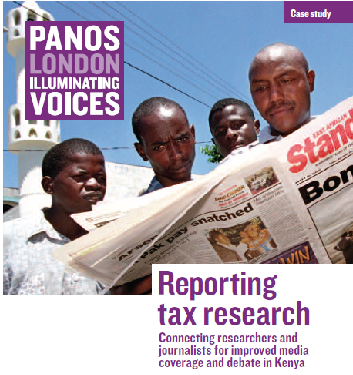
This 20-page case study describes some of the methods and activities developed by Relay, a Panos London-managed media and research communication programme, to improve Kenyan reporting on government accountability and transparency in relation to the collecting and use of tax in the country. As part of this, Relay held workshops to build journalists' research skills to find and communicate stories, and foster relationships between journalists, researchers, and civil society actors. According to the case study, greater transparency is essential to improving governance in Kenya and the media has an important role to play in this.
According to the report, Kenya has been decreasing its dependency on aid and debt while increasing its dependency on tax to finance development, including expanding access to education and health services. However, the report maintains that the transparent collection and use of public funds remains problematic. The case study outlines how the Kenyan media is already playing an important role in generating debate around government activities and the acquisition and spending of public money, but it has yet to scrutinise and debate the relationship between public spending (including corrupt spending) and taxation. The report notes that generating debate over this issue is important for Kenya's development and for the democratic process.
As the report states, journalists face numerous challenges in reporting on tax, including a lack of technical knowledge on the subject and its relation to development. Conversely, researchers - possible sources on the subject - lack an understanding of how to communicate their findings to non-specialist audiences such as journalists and have little confidence that journalists will accurately report their findings, which creates a relationship of mistrust between the two.
To overcome these challenges, Relay adopts a myriad of approaches when training journalists and researchers, including producing publications geared towards improving research-based reporting, workshops, media fellowships, and forums bringing together researchers, media, and civil society. Following initial workshops and subsequent media fellowships, Panos London noted an increase in tax-related coverage among participating journalists. As part of this coverage, journalists reported that they drew on workshop contacts, which they had also shared with colleagues. According to the report, many of the published pieces referenced research and public documents. Workshop participants also went on to establish a network, the East Africa Tax and Governance Network (EATGN), to promote public debate on tax and governance.
The report concludes that the Kenyan media has a strong and assertive presence and therefore has the capacity not only to inform people about who is paying taxes, but also to generate debate about what should be happening to these taxes, making the government more responsive and accountable to its citizens. The case study also mentions that the methodologies described in this Kenyan case study can work well not only in better resourced contexts with strong media such as Kenya, but also in more resource-poor environments such as Zambia. Relay's work begins from the premise that research on development issues can add depth and weight to what is being communicated to the wider public through the media. Research also allows for greater scrutiny of complex and technical issues such as taxation. In addition, researchers can help journalists make issues more relevant and meaningful to wider publics.
Panos London website on December 22 2011.
- Log in to post comments