










































Promoting Health and Literacy for Women's Empowerment
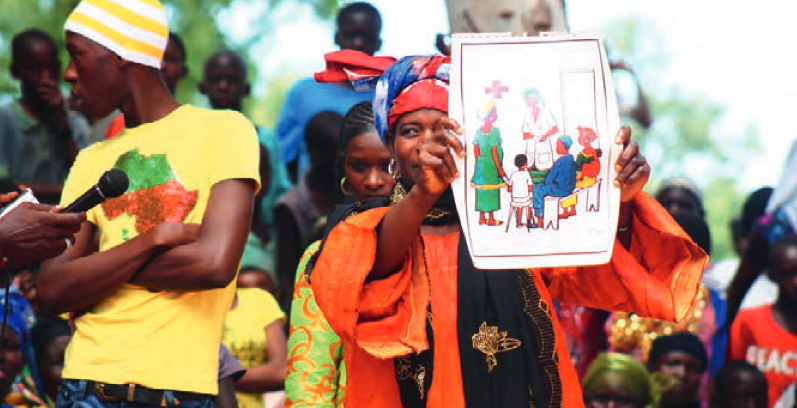
"I am convinced that the intrinsic value of literacy and education, extending far beyond economic development, is to empower people. This means enabling women and men, through education, to take control of their own health and well-being as well as to determine their own futures". Arne Carlsen, Director, UNESCO Institute for Lifelong Learning
Published by the UNESCO Institute for Lifelong Learning (UIL), this paper reflects on how youth and adult literacy, with a particular focus on young and adult women, can support health enhancement and women’s empowerment. Using project examples from across the globe, it looks at what works in terms of programme intervention and good practice, and offers recommendations for the way forward. Most of all, the paper argues for a cross-sectoral approach to the provision of adult literacy, education and training, and a situation where policymakers move “beyond an inward-looking ‘silo’ mentality and instead bring together health, literacy and gender equality in institutional collaboration and integrated programmes.” The paper shows how this integrated approach to literacy programmes for young people and adults can contribute to the achievement of three Sustainable Development Goals (SDG) - SDG 3: Ensure healthy lives and promote well-being for all at all ages; SDG 4: Ensure inclusive and equitable quality education and promote lifelong learning opportunities for all; and SDG 5: Achieve gender equality and empower all women and girls.
As stated in the Foreword, “The relationship between health, gender equality and education has been extensively investigated. The existing literature sheds particular light on aspects related to literacy for young and adult women. On the one hand, it shows how the acquisition of literacy skills contributes to improving people’s health, while also fostering the empowerment of women. It is well documented that those who have had access to literacy and education tend to adopt healthier behaviours and have a greater measure of control over their bodies. On the other hand, progress in health outcomes and gender equality can also be seen to strengthen the literacy skills of both women and men, demonstrating an interdependent cause-and-effect relationship between the three domains: education, health and empowerment.”
In order to investigate best practice for implementing programmes that integrate all three development issues, the paper starts with a review of research and policy in the fields of health, literacy, and women’s empowerment in order to help create a common understanding between professionals – health practitioners and educationalists – of what is meant by terms such as literacy, health, ‘health literacy’, learning and empowerment within these different fields. The review of the different terms highlights the following key principles for investigating literacy programmes from a health and gender equality perspective:
- The concept of health as a state of well-being goes beyond disease and health provision to embrace a social justice agenda.
- The relationship between women’s literacy and health can be investigated through looking at what kind of literacy learning and what kind of health learning supports empowerment processes.
- Women’s empowerment also involves informal learning about relationships, communication, social action and change beyond (as well as within) adult literacy and health education programmes.
In order to identify good practice in using a multi sectoral approach, the paper looks at programmes that address a number of health-related sub-themes connected with specific SDG3 targets. These are: maternal health and child health (MCH), community health and nutrition, HIV/AIDS prevention, and mental health and wellbeing. The following are just a few examples of projects discussed in more detail in the paper:
- The Tostan Community Empowerment Programme in Senegal illustrates a participatory rights-based approach to literacy, gender and health, which connects with a broader life course approach to maternal, child and adolescent health. The programme is underpinned by the broader understanding of literacy as multimodal, involving oral, print and digital communication and lifelong/life-wide learning.
- In Afghanistan, the REACH (Rural Expansion of Afghanistan’s Community Healthcare) programme engaged with Islamic teaching about contraception. The programme used quranic verses that justified spacing of pregnancies to communicate with both women and men, and produced a sheet of ‘common myths about birth spacing.” A literacy programme called Learning for Life (LfL) was developed to build women’s confidence and self-esteem so that they could take a greater part in family decision-making.
- The Alternative Community Education Programme (ACEP) in the Philippines works with indigenous Ubo and T’boli people in Mindanao who have limited access to health and education services. The programme brings together women in literacy classes to reflect critically on T’boli knowledge and cultural systems, whilst also learning about modern knowledge systems.
- In Brazil, the Alfabetizando com Saúde programme provides adult literacy classes that promote health awareness. A curriculum was developed around local health issues, and participatory methods are used, including drama, debates, and role play.
- The Jeunesse et Développement (Youth and Development) programme in Mali illustrates the importance of adopting a health promotion approach, which uses participatory learning (including literacy, health and political awareness) to set in motion a process of empowerment and capacity building.
- In Yemen, the Literacy Through Poetry project developed an adult literacy pedagogy based on community story-telling and poetic creative practices. Women came together to learn reading and writing skills through using their own stories, poetry, and proverbs.
Overall, the project review reveals how women’s empowerment, new gendered identities and more equal gender relations can emerge through adult literacy learning. Recognising the diversity of aims, institutions, and pedagogical approaches explored through the examples, the following are identified as some of the key aspects that informed their success:
- Understanding and identifying appropriate target groups (literacy and health for women, for men – or everyone) - Whilst a majority of programmes identified women as their major beneficiary group (and within this group, a particular focus on women of reproductive age), there was strong recognition of the need to involve men and the wider community.
- Promoting critical approaches to health and literacy for women’s empowerment - programmes incorporated some form of empowerment while promoting health and literacy, either by adopting a participatory pedagogy, or through a more traditional educational approach to literacy and health education.
- Responding to specific contexts and recognising the importance of understanding cultural practices, relationships between local and official languages, indigenous knowledges and structures.
- Recognising that empowerment is not dependent on a particular starting point or literacy approach - There can be a tendency to assume that only critical literacy approaches and a participatory bottom-up curriculum can facilitate women’s empowerment. However, this review suggests that a top-down centrally designed literacy programme implemented through formal classrooms might also be empowering for specific groups of women – who, for instance, wanted to catch up on schooling that they missed out on as children. What many of the programmes have in common is a social justice agenda on literacy, health and empowerment, which encourages a view of women as active citizens.
- Building sustainability for long-term provision - Grassroots initiatives often worked in partnership with the community once external funding ended to remain sustainable, while others were developed through the municipal health departments and so could rely on existing infrastructure.
Building on the best practice highlighted in this paper and formulated in the context of the 2030 Sustainable Development Agenda and the changing global landscape, the following recommendations are proposed:
- A broader, holistic understanding of health as well-being is needed within the education sector so that literacy programmes can support SDG 3.
- Adult education and literacy policy and programmes should urgently respond through the use of flexible, creative and innovative pedagogy and use of technologies to wide-spread changes taking place in the literate environment.
- Building on learners’ prior experience and valuing local knowledge, culture and language, a diversity of approaches to literacy, health and empowerment should be used.
- Organisational and personnel structures need to be given particular attention when developing literacy and health programmes for women’s empowerment.
- Health and literacy policy and programmes should shift from an instrumental to a transformative approach to women’s empowerment and gender equality.
UIL website on June 6 2017.
- Log in to post comments