










































Presenting the Evidence for Social and Behavioural Communication
This 21-page paper, published by Johns Hopkins Health and Education in South Africa (JHHESA), with inputs from Health and Development Africa (HDA), Soul City Institute for Health and Development Communication, LoveLife, and Community Media Trust (CMT), argues that HIV communication is effective, cost-effective, and a crucial counterpart to clinical HIV prevention interventions. The paper describes a range of HIV communication programmes that aim to tackle specific aspects of knowledge, motivation, attitudes, norms, or behaviours in a way that will have a knock-on effect in terms of reducing new HIV infections. The evidence cited is not focused on reduction of HIV incidence; however, it does show both the impact of communication programmes in terms of social or behavioural outcomes and also the clear evidence that these social and behavioural outcomes are reducing the incidence in South Africa and in a number of other countries.
According to the report, debate on the value of communication for HIV and other health interventions have been ongoing, but two important new developments are occurring. The first is that there has been considerable expansion within the clinical toolkit for HIV prevention, and the second is that confusion about how to interpret findings of different communication-related studies and a growing desire to base interventions on the kind of straightforward evidence that clinicians are comfortable with is undermining the legitimacy of HIV communication programming.
The report assesses a number of HIV communication programmes in South Africa, including Siyanqoba Beat It!, Khomanani, the Scrutinise campaign, the Soul City OneLove campaign, the TV serials Tsha Tsha and Heartlines, and LoveLife. The report states that all of these programmes have led to increased condom use, increased voluntary counselling and testing, and a reduction in sexual partners. It also looked at the relative cost effectiveness of communication programmes, concluding that behaviour changes in South Africa had averted 701,495 infections in 2005, saving US$281 million over the period of a year. In addition, the combined total cost for the five largest health communication programmes and all of their subsidiaries and grantees in South Africa is less than a quarter of the combined advertising expenditure of South African alcohol industries.
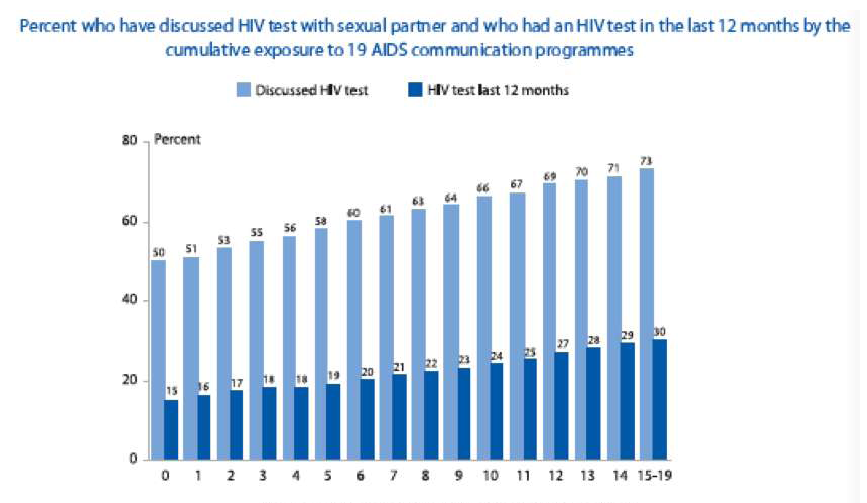
According to the report, there is ample evidence that social and behaviour change communication is having an impact and that South Africans are heeding the messages and taking action to avert new HIV infections. Communication programming has reached over 90% of the population, leading to a significant improvement in HIV-related knowledge, attitudes, and beliefs. It has also had a direct impact on a number of behaviours, including partner reduction, HIV testing and counselling, and condom use.
The report argues that the debate over lack of evidence is founded on misunderstandings about the nature of HIV prevention. Averting new infections is rarely a one-step process, where a single intervention will have measurable results at the level of HIV incidence. However, more work needs to be done, and there are significant gaps and areas of weakness - for example, in interpersonal and community-level communication, leadership, coordination, and technical capacity, particularly in relation to building the evidence base for communication.
The paper concludes that behaviour change communication programmes and biomedical approaches should be supported as working hand in hand. The hard-won gains in bringing down levels of risky behaviour, increasing knowledge levels, and national HIV infection rates could easily be reversed if communication is not continued and intensified.
JHUCCP website on May 16 2011, link replaced December 4 2014.
- Log in to post comments