










































Phalombe Malaria Communities Project
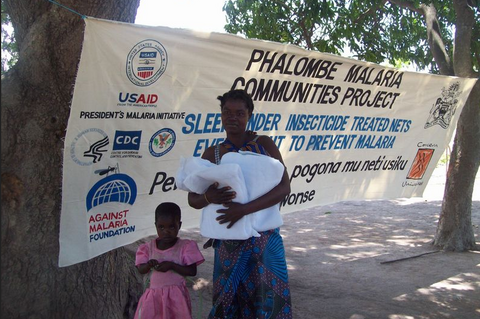
The Phalombe Malaria Communities Project uses radio programmes, posters, flyers, and malaria ambassadors to reach mothers and caregivers with information about malaria prevention and treatment. The project also works through Village Health Committees (VHCs), who conduct community awareness on malaria through home visits and net demonstrations. Initiated in 2009, this is a project by Concern Universal in collaboration with the Phalombe District Council, with funding from the President’s Malaria Initiative (PMI).
With the intent of reaching the various communities in the district, the Phalombe District Council (PDC) conducted community campaigns and road shows. According to Concern Universal, these campaigns reach 184,000 people per annum through the strategic use of community/national radios, which included dialogue sessions, news bulletins of malaria events, mass campaigns, and malaria songs. To promote malaria prevention in communities, the project coordinators also identified villages showing best practices in malaria prevention, who were then given airtime on the radio to present their experiences. Leaders from these villages are also given the opportunity to conduct tours to other villages for peer education purposes.
The PDC also advocates to make malaria action part of national agenda, working with 35 key political leaders at district and community levels to advance malaria policy issues to parliament. PDC plans to hold 10 events and debates with politicians and traditional authorities on issues requiring the formation of by-laws that could safeguard abuse of ITNs, malaria drugs, and other supplies. In addition, PDC is identifying 2 Malaria Ambassadors (1 male and 1 female) within communities, who are intended to act as role models to disseminate malaria prevention messages through campaigns, information, education, and communication (IEC) materials, radio, wall brandings, and billboards. 30,000 IEC materials have been printed for low literate audiences. Malaria Ambassador Emanuel Bambe, District Councillor for Phalombe District, was depicted on 600 posters in a malaria campaign to encourage men to take part in care seeking practices when their children have fever and encourage their pregnant partners to start attending antenatal clinics.
The project also encourages community monitoring and evaluation through quarterly review meetings with volunteers, health workers, and leaders.
Concern Universal is also working in partnership with district stakeholders and is building the capacity of new and existing community structures such as Village Health Committees (VHCs). Each of the 460 villages in the project area has a VHC whose members have been trained in basic malaria information by the project.
Malaria
Malaria is the leading cause of morbidity and mortality in Malawi for children under five years of age and pregnant mothers. In 2007, malaria affected 34% of Malawi’s population. It is the most common cause of outpatient visits, hospitalisation, and death and is responsible for about 40% of all under-five hospitalisations and 30% of all hospital deaths in under-five children. It is estimated that there are between 30 and 50 infective mosquito bites per person per year. Plasmodium falciparum is by far the commonest species, accounting for 98% of the malaria infections.
Concern Universal (CU) implemented the Phalombe Malaria Communities Project (PMCP) in Phalombe District in the Southern region of Malawi as Phalombe is one of the districts with high prevalence among under-five children (62%), high malaria cases of the total population at 21%, and an increased percentage of malaria cases in outpatient attendance of 23%. According to the Malawi Indicator Cluster Survey (MICS) report of 2006, Phalombe has a low coverage of 28.7% for households that own at least one ITN and ITN usage amongst under-five children remains as low as 21%. These statistics indicated low adoption of malaria prevention practices in the targeted community. The project fits well with the President’s Malaria Initiative (PMI) and it addresses National Malaria Control Programme (NMCP) identified needs and gaps.
United States Agency for International Development (USAID), President’s Malaria Initiative, Concern Universal, Against Malaria Foundation.
- Log in to post comments