










































Improving Communication Between Aid Agencies and Crisis-affected People: Lessons from the Infoasaid Project
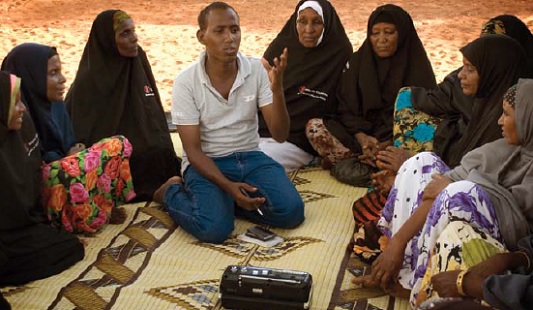
This 30-page paper, commissioned by the Humanitarian Practice Network (HPN) at the Overseas Development Institute (ODI), discusses how communication can be used in emergency contexts to improve humanitarian responses, with particular focus on the infoasaid project experience. Infoasaid was implemented from 2010 to 2012 by BBC Media Action and Internews, with funding from the United Kingdom Department for International Development (DFID), "to improve the quality of humanitarian response by maximising the amount of accurate and timely information available to humanitarian responders and crisis-affected populations through enhanced communication between them in an emergency." It included the development of a set of humanitarian communication tools and pilot projects designed to address the drought and insecurity crisis affecting areas of Kenya and Somalia. These pilot projects used community radio and mobile phone applications to disseminate information and engage communities.
As stated in the paper, there is increasing understanding of the important role that media and communication play in emergency situations for gathering and disseminating relief information, as well as mobilising people. The rapid explosion of information and communication technologies (ICTs) has not only improved the ability to communicate with people affected by a crisis, but has also created channels in which the affected population can engage in dialogue with humanitarian responders, provide feedback, and even offer logistical insights that may not be known to responders. These technologies have also allowed emergency relief operations to crowdsource information so that they can better respond to the needs of people in crisis.
This increasing understanding and role of media communication in emergencies requires new collaborative relationships between the humanitarian community and media and communication professionals. One component of the infoasaid project was the development of a set of tools to help support this interaction. The tools included a message library, a set of media and telecommunication guides for disaster-prone countries, and an e-learning course on who should communicate, and how, in an emergency. (The paper includes detailed information about the tools and their development processes).
Infoasaid also included five pilot projects, which are outlined in chapter 4, which also discusses key findings from three internal learning reviews conducted six to nine months following the implementation of the pilot projects. The pilot projects took place in Somalia and Kenya under agreements with locally operating organisations. Each of these pilots included setting up information/ communication hubs and networks. Wherever possible, the pilot project used community radio stations, and involved mobile telephone communication to encourage engagement, such as Freedom Fone software and telephone hotlines.
The learning reviews found that the communication projects fulfilled important information needs in the communities on diverse subjects such as health and nutrition, and market practices. The projects also helped improve two-way information flows between humanitarian organisations and the communities they were working to assist. "Findings from all three reviews suggest that increased interaction with drought-affected communities, enabled by the community radio show and mobile phones, not only improved each organisation's understanding of communities' needs and priorities but also led them to make changes to their assistance." This improved relationship helped the affected population to become active participants in the humanitarian response.
In conclusion, the paper suggests that there are several key lessons learned from the infoasaid experience: the importance of advance planning, the need for communication for development experts within humanitarian organisations, and the need to motivate for greater prioritisation of communication as a vital part of humanitarian responses. Wherever possible, all communication interventions should begin with a needs and communication habits assessment, followed by a strategy that comprises multiple communication channels to facilitate community engagement and to amplify and reinforce messages. However, engaging the community requires efforts to not only collect information, but also to monitor and report back on the information gathered. Lastly, the paper points out the importance of monitoring and evaluation to create an evidence base about what works and what doesn't.
CDAC Network website on March 3 2015.
- Log in to post comments