










































Health Communication for Life (HC4L)
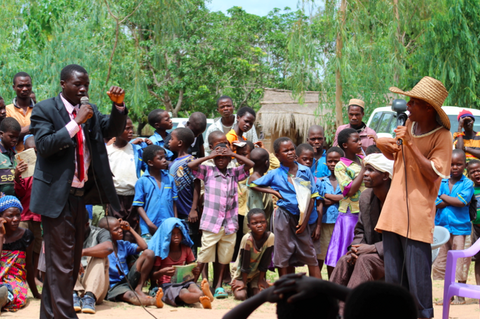
Health Communication for Life (HC4L) is a five-year project (September 2016 — September 2021) that seeks to support the Government of Malawi’s efforts to increase public demand for quality, sustainable, priority health services and products. The project works to expand citizens’ motivation, opportunity and ability to use these resources, while building the capacity of the government and key institutional partners to support national social and behavioral change communication (SBCC) programming. The project focuses specifically on increasing the demand for health care in these areas: family planning and reproductive health; HIV; malaria; maternal, neonatal and child health; nutrition; and water, sanitation and hygiene.
The project, coordinated by FHI 360 and funded by the United States Agency for International Development (USAID) Malawi, works with Malawi Government through the Ministry of Health (MoH) - Health Education Services (HES), and strategic national and international partners (sub-contractors), namely: Theatre for a Change (TFaC), Youth Net and Counselling (YONECO), the Story Workshop Educational Trust (SWET), Creative Centre for Community Mobilization (CRECCOM), Human Network International (HNI), and the University of Witwatersrand (UofW).
To increase demand for quality priority health services, the main focus of the project is to execute evidence-based or innovative SBCC interventions related health that contribute to the achievement of four interrelated and interdependent intermediate results (IRs):
- Health-seeking practices improved,
- Government of Malawi (GoM) capacity to lead national SBCC programming improved,
- Capacity of key institutional partners to design, implement, and evaluate high-quality SBCC improved, and
- Use of data for SBCC decision making improved.
According to FHI360, “SBCC or health communication is defined as the coordinated use of a range of communication approaches – including mass (television, print, and social media), community and interpersonal communication (IPC) messaging - to influence individual and collective behaviors and social norms in support of improved health outcomes. High-quality SBCC is an essential element of health programming as it shapes not only demand, but also client-provider communication, couple communication, and engagement of community leaders and other influencers”.
The project uses a range of mass media communication strategies such as print materials, television, radio, and mobile phones, as well as interpersonal outreach activities, including listening clubs and interactive community events. All communication activities are guided by the Life Stages SBCC Approach with more horizontal messaging across disease areas according to the needs of life stages of the audience. The project also utilises Participatory Action Media, which is an audience-driven, bottom-up approach to message development. Participatory Action Media incorporates audience perspectives, insights, reflection and problem-solving into the development of communication strategies, concepts and products.
HC4L also works to strengthen national capacity, build leadership, and improve coordination for sustained health outcomes. Specifically, HC4L supports the GoM and the Ministry of Health (MOH) to better coordinate and lead national health communication across a variety of key stakeholders, including standardised health communication materials development and SBCC training through the zonal and district levels.
Project activities are being carried about by the consortium members who each bring their unique set of skills and experience to achieve the programme objectives. The partners and a brief outline of their roles are as follows:
- FHI 360 is the prime contractor for HC4L, coordinating the work of all team members, serving as the point of contact for Government of Malawi counterparts and for USAID, overseeing technical direction of SBCC and capacity strengthening activities, ensuring that work is completed on time, is in line with the approved budget and of optimal quality.
- The Story Workshop Educational Trust (SWET) develops materials, radio and television programming, and targeted community outreach.
- Creative Centre for Community Mobilization (CRECCOM), with on-the-ground capacity, to mobilize communities, engage community radio stations and radio listener clubs, collaborates with other community mobilisation partners on all activities.
- Youth Net and Counselling (YONECO) works to leverage existing programmes, expand radio coverage, mobilize listener clubs, and collaborate on creating demand for health services.
- Theatre for a Change (TfaC) leads the development of SRH/FP/RH-related programming, expands HC4L’s ability to reach audience via both radio, and implements interactive community-based activities.
- University of the Witwatersrand (UofW) will 1) Develop academic programmes in collaboration with the University of Malawi (Chancellor College and the Polytechnic); 2) adapt existing SBCC training materials; 3) facilitate workshops and trainings; and 4) assist quality assurance/quality improvement (QA/QI) systems development.
- Human Network International (HNI) will facilitate the use of information, communication and technologies (ICT) to improve project efficiency and productivity in relation to demand creation and data collection, specifically: 1) develop and place SBCC programming on its 3-2-1 platform, an innovative mobile phone information service that allows people to use their simple mobile phones to proactively retrieve information across a range of topics; 2) establish a mobile- and ICT-based M&E system to track project outcomes e.g. interactive voice response (IVR); and 3) develop mobile phone-based cohort and cross-sectional surveys and data collection.
Family planning and reproductive health; HIV; malaria; maternal, neonatal and child health; nutrition; and water, sanitation and hygiene.
Context:
Malawians face the quadruple burden of communicable and non-communicable diseases, trauma-related conditions, and reproductive health (RH) and maternal, neonatal and child health (MNCH) problems. Ranked among the world’s least developed and most densely inhabited countries, 80% of the population of nearly 17 million live in rural areas, more than 50% live below the poverty line, and nearly 40% are illiterate. Despite ongoing efforts, lingering health challenges persist and are exacerbated by socio-cultural, religious and gender norms as key health determinants. These include issues associated with different life stages and age categories, literacy levels, wealth and geographic disparities. Malawians hold strong cultural convictions about who should seek what health services when and why, decisions often controlled by dominant and influential family members (‘uncles and aunties’) and religious leaders, and which impact demand generation and health-seeking action (ability, opportunity, motivation).
The total fertility rate in Malawi is 4.4 children per woman (MDHS, 2016). Although down from 5.7 (MDHS 2010), this remains one of the biggest potential development problems in Malawi. It is worsened by child marriage, transactional sex, and high pregnancy rates for girls, and relatively low contraceptive prevalence among married women. In Malawi evidence shows that age for first sex among young people aged 15-24 is low (14 years old for girls, 19 years old for boys); and 22% of young women aged 15-19 are already mothers. Although the knowledge of contraception is almost universal, only 58% of Malawians use modern methods of contraception. With 67% of the population currently under 25 years of age, and likely to triple by 2050, the GOM’s ability to meet healthcare needs with quality, timely, and sustainable services and resources is concerning as some health indicators are still relatively poor. Currently, the neonatal mortality rate has decreased to 27 per 1,000 live births in 2016 from 41 per 1,000 live births in 2010. The infant mortality rate is estimated at 42 per 1,000 live births; under-five mortality at 63 per 1,000 live births; and maternal mortality, although considerably improved, is still high at 439 per 1,000 live births. The most recent evidence in Malawi shows that about 6% of children aged between 9-11 months have low hemoglobin and are most likely severely anemic, 37% of the under-five children are stunted, or too short for age, and underweight prevalence in this group, although declined from 24% in 1992 to 12% in 2016, is still high.
FHI 360, USAID, Malawi Government through the Ministry of Health (MoH) — Health Education Services (HES), Theatre for a Change (TFaC), Youth Net and Counselling (YONECO), the Story Workshop Educational Trust (SWET), Creative Centre for Community Mobilization (CRECCOM), Human Network International (HNI), and the University of Witwatersrand (UofW).
HC4L Fact Sheet and FHI360 website on May 19 2017.
- Log in to post comments