










































Epidemic Ready: Community Engagement Key in Fight against Ebola
Motivated by the belief that community engagement is essential at all stages of epidemic preparedness and response, at the height of the Ebola virus disease epidemic in West Africa, the International Federation of Red Cross and Red Crescent Societies (IFRC) launched a social and behaviour change communication (SBCC) project designed to halt transmission and stop the disease from spreading to neighbouring countries in the region. This IFRC case study describes the project and some of the lessons learned that emerged from it.
Implemented from 2014-2016 with European Union (EU) funding, the West Africa Preparedness Project focused on Nigeria, Senegal, Guinea-Bissau, Gambia, Burkina Faso, Mali, Benin, Togo, Ghana, and Cote d'Ivoire, as it undertook stakeholder and media mapping, assessment of risk perception, identification of trusted sources of information and commonly used communication channels, and knowledge, attitudes, and practices (KAP) studies. The information that emerged helped shape SBCC plans, which were developed and implemented in partnership with government, media outlets, and telecommunications providers. SBCC activities and messages were continually adapted based on feedback from communities to ensure that they were effective at addressing myths, rumours, stigma, and misinformation.
Examples of project activities include:
- Health communication products and materials specific to the priority epidemic diseases and health issues in each country were developed. This includes short radio spots, longer radio programmes, posters, flyers, and video documentaries - all in local languages and tailored to the different contexts in each country.
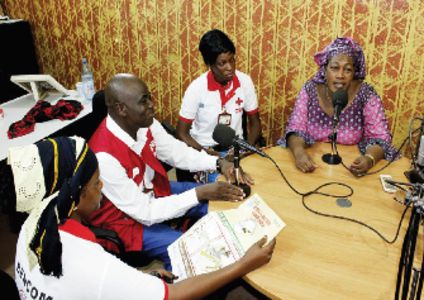
- More specifically, more than 10,000 interactive radio programmes anchored by both Red Cross volunteers and media practitioners were conducted across all 10 project countries. Use of radio allowed National Societies to scale up their audience, raise the profile of the Red Cross, and improve engagement with communities. The live radio shows were interactive, allowing 2-way communication, so that National Societies could listen, answer, guide, and address people's specific health and information needs. Often, the radio shows included quizzes and drama performances.
- Almost 600,000 beneficiaries were directly reached through household visits, focus group discussions, and community meetings.
The case study illustrates the 5-step process that was used to ensure community-driven programming, which emphasises engagement, listening, and acting on community feedback. This process is part of IFRC's Community Engagement and Accountability (CEA) approach, also outlined here. Harmonised, contextualised tools and approaches for data and feedback collection, project monitoring, and responsive programming were developed; they changed based on feedback. This approach, called Model E, is a detailed breakdown of the 5 steps for CEA and was developed through consultation with the 10 IFRC West African National Societies. Data were collected using a variety of different tools and mechanisms, including KAP surveys. Selected results from endline KAP surveys are provided in the case study. For example, improved knowledge of the main transmission routes for measles, polio, and meningitis was reported in Mali. At the endline survey, 62% of respondents said that polio spreads through oral contact with infected food, dirty hands, or dirty water - an increase of 37% from the baseline.
In addition to listing main achievements, the case study lays out challenges, lessons learned, and recommendations, including, in brief:
- Integrate CEA into programmes and operations.
- Work to ensure buy-in and understanding of CEA; this takes time but is critical, especially for those in leadership and decision-making roles.
- Cultivate solid relationships with the Ministry of Health (MoH) and other stakeholders.
- Build and share CEA capacity.
- Take advantage of technology (e.g., data collection using mobile phones), and use data for decision-making.
- Ensure strong project management from day one.
- Recognise diversity, and make sure messages and strategies are tailored and relevant.
- Constantly collect, analyse, and share feedback.
- Extend preparedness project timeframes: behaviour change takes time.
- Identify and engage influential community opinion leaders.
- Listen to communities before acting so that communities feel valued by National Societies.
Several additional recommendations for action are provided, moving forward, such as: ensure that community engagement specialists are trained and ready to be mobilised in the case of an epidemic or emergency.
IFRC website, May 2 2018. Image caption/credit: An interactive radio programme underway as part of the EU-funded West Africa Ebola and other epidemic disease preparedness project. Credit: IFRC
- Log in to post comments