










































Emerging Good Practices in Migration and HIV Programming in Southern Africa
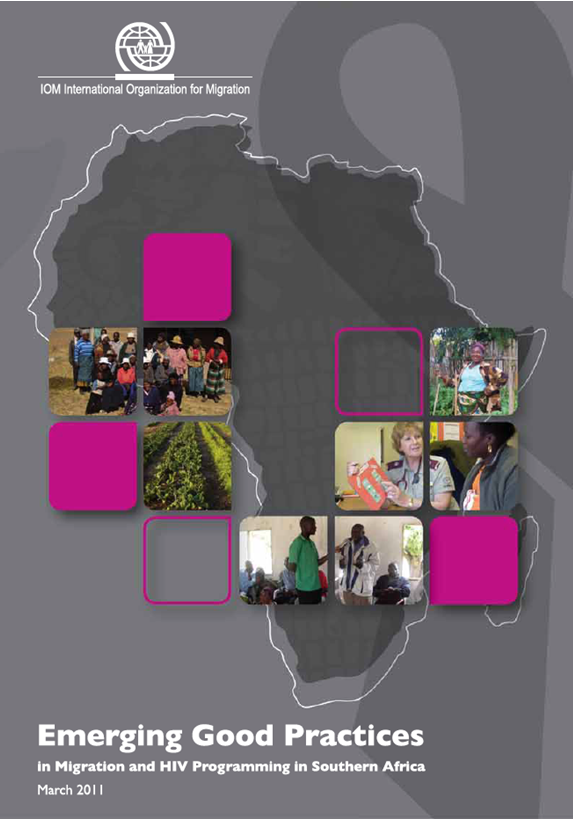
The 86-page report, published by the International Organization for Migration (IOM), was produced to identify, assess, and document emerging best practices based on work done in pilot projects under the IOM's Partnership on HIV and Mobility in Southern Africa (PHAMSA). PHAMSA projects are based around a comprehensive HIV model, and implemented in migration-affected communities, in collaboration with partners, in Swaziland, Mozambique, Lesotho, South Africa, and Zambia, mostly within mining and agricultural sectors. According to the assessment, using the IOM's health promotion and service delivery (HPSD) project model as a framework helped to guide local partners and ensured a common vision and objectives, but allowed each intervention to be adapted to their own context.
The HPSD model is based on health promotion and community development theory and strives to address both contextual and individual barriers to behaviour change. Key to the model is social and behavioural change communication (SBCC), which is a bottom-up, rights-based approach that seeks to provide an opportunity for positive change through communication, and encourages beneficiaries to take action in their lives and communities. According to the report, the "bottom-up" approach to social and behavioural change sparked renewed passion amongst "HIV-fatigued" communities, since the author says it responds to real needs at the local level rather than providing traditional HIV interventions.
Central to the process are change agents, who are members of the community that the programme seeks to reach who are recruited and oriented in all sites and are the core of the face-to-face communication and empowerment process. They: disseminate HIV/health-related information and promote adoption of healthier and positive behaviours and practices amongst their peers and communities; engage in dialogue with peers to identify challenges in the community; develop strategies to address the challenges; and promote action for change.
The report found that addressing gender-specific vulnerabilities to HIV/AIDS within a migration context by using such communication strategies encouraged both men and women to promote action to address harmful gender practices, and identifying cultural gatekeepers has been key to supporting and promoting social and behavioural change at the community level.
According to the author, by building a network between implementing and technical partners, lessons have been shared between different organisations working in similar fields. Actively promoting learning and exchange saw the partners sharing and learning from each other, which has led to replication of tools and processes.
In addition, the projects provided an opportunity for evidence to be gathered about marginalised groups - migrants, their families, and communities affected by migration. This information can be used to ensure relevance and effectiveness, and at a national and regional level to support awareness raising, advocacy, and resource mobilisation.
The assessment report includes both programmatic as well as policy and advocacy recommendations. According to the author, there is enough success identified in all the project sites to warrant the scaling up of the model, and IOM should document and disseminate tools that could be used to assist others to develop or implement projects in spaces of vulnerability. IOM and partners should also build on the success of the SBCC approach. Sustainability is a key challenge, and projects need to focus on developing sustainability plans.
The report also recommends that partners' roles in advocacy on issues around gender, migration, and HIV need to be defined and capacity built to enable partners to influence local, national, and regional policies and programmes. In addition, at the national level, there is a need for greater advocacy on migrants' health rights. Using the experience and evidence gathered through these projects, IOM and partners should lobby and advocate with government and other institutions.
The author concludes that dialogue around gender, migration, and HIV appears to be a useful tool for sustainable social and behavioural change, since it is the intended group themselves who decide what action to take. The findings suggest that the IOM health promotion and service delivery approach can be used effectively to respond to gender, migration, and HIV in southern Africa, and that this can be used as a tool to influence programming across the region in other spaces of vulnerability.
IOM Regional Office for Southern Africa website on June 27 2011.
- Log in to post comments