










































Dimitra Clubs: A Unique Approach
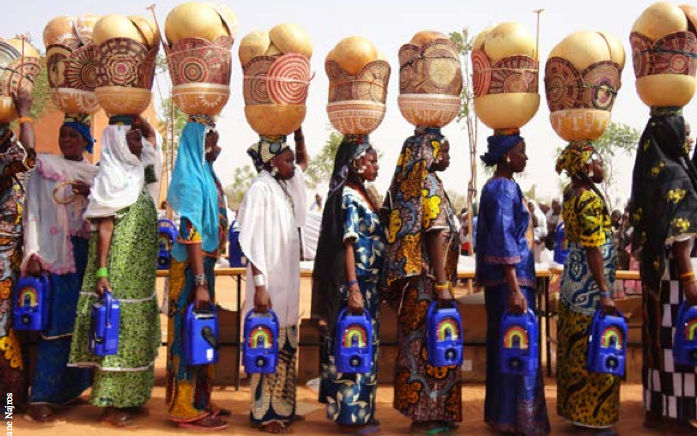
“Over 1500 Dimitra Clubs exist in sub-Saharan Africa today, involving about 50.000 women and men”.
This factsheet looks at the Dimitra Clubs approach used by the Food and Agricultural Organization (FAO) Dimitra Project, a gender-sensitive information and participatory communication programme that promotes individual and collective socio-economic empowerment of rural populations - women and youth in particular. The factsheet describes the clubs as follows: “FAO Dimitra listeners’ clubs are groups of women, men and young people - mixed or not - who decide to organize themselves to work together to bring about changes in their communities. They meet regularly to discuss the challenges they face in their daily lives, make decisions and take action to resolve their problems.”
According to this factsheet, the Dimitra Clubs’ approach involves the following formula: “the determination of community members to mobilize, a wind-up solar-powered radio - sometimes paired with a mobile phone, close collaboration with community radio stations, support from FAO, some flexibility and ... the process can start!” As part of the process, rural radio stations are used as an information media relay to increase the communication flow, provide access to knowledge, and raise awareness on themes that have been identified and requested by the clubs themselves (agricultural practices, food security, gender-based unequal workload, access to water, land, sanitation, health, etc.). The clubs' members interact within their own club or with other clubs by using solar-powered and wind-up radio sets.
The factsheet highlights the eight key features of these clubs, as well as the different areas of impact achieved by this approach:
- Access to information and communication - The clubs enable members to access relevant information that responds to their needs (for example, about available services, market access, prices, agricultural innovations, etc.) and to communicate on any subject that is of interest to them, in particular through discussions in the clubs and radio broadcasts.
- An action-oriented mechanism - Club members hold discussions to find and implement solutions to development problems that affect the community.
- Autonomy and ownership - The clubs manage themselves and decide how they should be run, including the subjects to be discussed, the frequency of meetings, and the type of monitoring.
- Participation - The clubs stimulate the active and voluntary participation of the whole community, whether it concerns decision-making, discussions, or actions.
- Gender approach and gender equality - All members, whatever their sex and social standing, have the opportunity to make themselves heard.
- Networking - The clubs are part of a network that seeks to share and build on experiences. At the community level, interaction is at the core of the approach, whether it be between listeners’ club members or with other listeners’ clubs, community radio stations, government services, or other development partners.
- Collaboration with community radio - The clubs do not depend on radio stations, but they develop a win-win partnership with them, based on confidence and mutual respect. Partner radio stations relay the voices of club members and become "radios by the community, for the community".
- Support from FAO-Dimitra - During the first few years, the clubs receive guidance and strong technical support in order to ensure the principles and features of the clubs are upheld.
The following are some of the areas of impact, which are described in more detail in the publication:
- Access to information
- Social mobilisation and improved local governance
- Access to productive resources
- Structuring the rural world by encouraging the creation or strengthening of rural organisations
- Empowerment and capacity development
- Behavioural changes in areas such as agricultural practices, nutrition and food security, gender, health, and education
- Transformation of gender relations, especially regarding roles and responsibilities in households and the community
- Women’s increased self-confidence, participation, and leadership
For more information, see the Related Summaries below.
FAO website on December 12 2016, and emails from the Dimitra Team to Soul Beat Africa and The Communication Initiative on December 12 2016 and February 23 2017, respectively.
- Log in to post comments