










































"Design for Democracy" African Style
Design Altruism Project
This article discusses the challenges, lessons, and impact of a national civic sensitisation campaign for the first democratic local elections in Rwanda, which were held in 2001. The purpose of the campaign, which involved the design and distribution of a series of posters, fliers, and graffiti images, was to educate citizens about the purpose and importance of voting, teach people to use a secret ballot, and motivate people to participate.
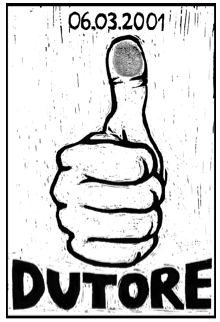
The concept for the campaign utilised the fact that most people sign official documents with a thumbprint, and would be using their thumbprint to vote. The author combined the image of an inked thumb with a "thumbs up" sign to produce a graphic that read: voting is good. Added to this image was the word "Dutore," which means "we vote." Two additional posters were created to visually communicate the process of using a secret ballot and the relevance of the local elections to people's daily lives. The posters employed a comic book technique since, according to the author, this was the most familiar and effective way to communicate a narrative and avoid visual references to ethnicity.
The author discusses the challenges in creating designs that: communicated equally to literate and non-literate voters; were sensitive to ethnicity and ethnic, political and economic division; and were culturally appropriate. Photographs, for example, could not be used, as they could inadvertently signify ethnic difference. Finding neutral images was also a big challenge, and, according to the author, proved impossible, as images used on some of the posters unintentionally sent out a negative message to voters that created a certain degree of fear around the electoral process.
The author argues that in order to create effective, relevant work, visual communicators need to work cooperatively with the communities to whom they are communicating. From conception to distribution, the audience needs to participate in the creative process in order for the communication to be effective. She also argues that images cannot be separated from social, political, and historic significance, and that it is important to consider possible unintended messages that images which appear "neutral" to an outside eye may project.
Design Altruism Project website on December 3 2008.
- Log in to post comments