










































Africa Indoor Residual Spraying (AIRS) Project
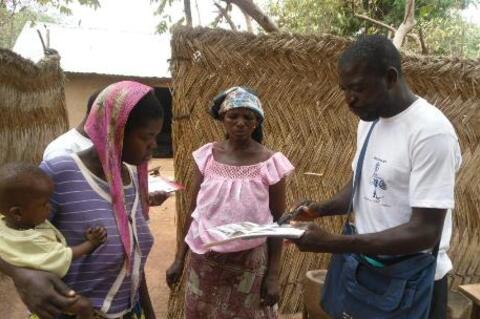
According to AIRS, spray operations are a highly complex logistical undertaking that requires meticulous planning at the national, district, and village levels. It entails conducting geographical reconnaissance to identify work sites, procuring insecticide and equipment, managing warehouses, and training thousands of local staff to spray homes and follow environmental and health guidelines. To ensure insecticide kills mosquitoes that carry the malaria parasite and reduces residents' chances of getting bitten, AIRS completes rigorous entomological monitoring that guides programmatic decisions.
A guiding principle of the project is to develop local capacity to lead IRS. In every country where AIRS works, the project is assessing the capacity of Ministries of Health and National Malaria Control Programs to implement IRS without foreign technical assistance. Stakeholders are using findings to identify opportunities to transition responsibilities from the project to country governments. In addition, AIRS has developed several tools and innovations such as supervision checklists and mobile environmental assessments to make IRS a more cost effective and sustainable malaria intervention.
AIRS also carries out communications campaigns to educate community members about the benefits of IRS. According to AIRS, communications campaigns are critical because at least 80% of households must accept indoor residual spraying for the programme to be effective at preventing malaria. Information, education, and communication campaigns are conducted using radio, village meetings, discussions with mothers at antenatal clinics, and door-to-door visits to increase acceptance of indoor residual spraying. Some of the communication strategies used include the following:
- traditional leaders and interpersonal communication channels to reach communities through trusted sources of information;
- community dialogues (community-based forums and call-in radio shows) to dispel myths or allay concerns about the spray process; and
- community-based mobilisers are integrated with spray teams to prepare households for the arrival of the spray teams.
AIRS ensures women are well represented among community mobilisers and spray operators, to facilitate higher community acceptance of the spray teams and expedite access to structures. In collaboration with National Malaria Control Programs, AIRS crafts custom communication objectives and messages for each country based on the maturity of the country’s IRS programme and its geographical scope. In parallel, the project is researching and refining existing communications strategies to increase IRS acceptance and compliance.
The project has developed a mobile phone application to facilitate communication. It is using mass text messages to spray staff to send reminders, reinforce training, and motivate staff. They also tailor messages to smaller staff groups to improve their performance. In addition, a site assessment checklist is pre-loaded onto a smartphone to ensure that all environmental compliance aspects of each operational site are inspected.
Malaria
According to Abt Associates, in 2012 alone, AIRS protected 6.82 million people in Africa from malaria including 182,524 pregnant women and 1.22 million children under five.
President’s Malaria Initiative, National Malaria Control Programs
Africairs website and Abt Associates website on November 12 2013.
- Log in to post comments